
Rolex Deepsea 116660
Sea-Dweller › 116660

The 116660 is the first production Rolex Deepsea. Rolex introduced it in 2008 with a black dial, a 44 mm steel case, the Ringlock system and a 3,900 m depth rating. It uses calibre 3135; Rolex added the D-blue dial in 2014.
Core facts
| Detail | Specification |
|---|---|
| Reference | 116660 |
| Model name | Oyster Perpetual Rolex Deepsea; often catalogued as Sea-Dweller Deepsea |
| Introduced | 2008 |
| Successor | 126660, introduced 2018 |
| Case | 44 mm; 17.7 mm thick |
| Material | 904L stainless steel middle case (now called Oystersteel); grade 5 titanium caseback |
| Depth rating | 3,900 m / 12,800 ft |
| Movement | Calibre 3135, automatic, date |
| Crystal | Rolex's 2013 brochure: 5 mm; its 2020 comparison and current page: 5.5 mm |
| Bezel | Unidirectional, black Cerachrom insert, platinum-coated graduations |
| Dials | Black; D-blue blue-to-black gradient with green DEEPSEA text, added in 2014 |
| Bracelet | Oyster ref. 98210; 21 mm, 11 links, Glidelock and Fliplock extension |
Rolex's 2013 brochure says the Deepsea was presented in 2008 and lists calibre 3135, the Ringlock case and its 3,900 m rating. Rolex's 2020 comparison and current technical page give more detail on the dimensions and case materials. Auction catalogues identify calibre 3135 and the 44 mm case on individual 116660 examples.
Place in the line
The 16600 was the 40 mm Sea-Dweller when Rolex introduced the larger 116660 in 2008. Rolex brought back a 40 mm model with ref. 116600 in 2014; it then ran alongside the Deepsea.
The 116660 uses the same case diameter and depth rating as its successor, ref. 126660. In 2018, Rolex updated the Deepsea with calibre 3235, a broader bracelet and changes to the lugs and case sides. Launch coverage dates the new generation; Rolex has not published a final factory-production date or total output for the 116660.
Production outline
Rolex introduced the Deepsea in 2008 with a black dial. Auction catalogues date individual black-dial examples to circa 2008 and circa 2009; those dates apply to those watches.
Rolex added the D-blue dial in 2014. Its blue-to-black gradient and green DEEPSEA lettering refer to James Cameron's 2012 dive to Challenger Deep. The watch attached to his submersible was the experimental Deepsea Challenge; the D-blue 116660 was the later production tribute.
Movement notes
The 116660 uses calibre 3135, an automatic movement with date and stop-seconds. Rolex's 2013 brochure identifies the calibre; auction catalogues list 31 jewels on the examples they describe. The movement guide gives 28,800 vph and an approximately 48-hour power reserve. See Calibre 3135 for the movement's construction and later fitments.
Dial map
The two main dial colors are black and D-blue. Rolex describes Chromalight as debuting on the Deepsea in 2008. The blue-glowing material appears on the hands, hour markers and bezel zero marker.
The 2012 Rolex Forums comparison and GINZA RASIN's photographed guide describe three black-dial print groups, usually called Mk I, Mk II and Mk III. Rolex does not use these labels, and collectors disagree about some boundaries. The guides compare coronet shape, letterforms and spacing around the depth rating; GINZA RASIN dates the groups partly from its own stock.
| Collector label | Reported print details | Approximate dating in dealer guides |
|---|---|---|
| Mk I | Earlier coronet shape and heavier print; GINZA RASIN also notes an angular S in SEA-DWELLER. | 2008–about 2009 |
| Mk II | Revised coronet and changes to the DEEPSEA lettering, hyphen and equals sign; GINZA RASIN notes a lower-case f in ft. | About 2009–2013 |
| Mk III | Fine spacing and print changes around the depth line; forum comparisons note differences in the space around the equals sign. | About 2013–2018 |
Treat these as descriptions of observed printing, not a serial-date chart. The two collector sources differ on some details and do not establish factory changeover points.
GINZA RASIN describes later D-blue dials with a brighter, wider blue area in stock it received in 2017. Its date is a dealer estimate, not a Rolex changeover date.

Case, bezel, crystal, and crown
The Oyster case measures 44 mm across and 17.7 mm thick. The middle case is 904L steel. The Ringlock system places a nitrogen-alloyed steel compression ring between the case and caseback; Rolex describes the caseback as grade 5 titanium. Rolex's April 2013 brochure calls the slightly domed sapphire crystal 5 mm thick. Its 2020 comparison and current technical page give 5.5 mm. Rolex's published figures differ, so both are recorded here. The depth rating is 3,900 m / 12,800 ft.
The 60-minute bezel turns in one direction and carries a black Cerachrom insert. Rolex's technical material describes platinum-coated numerals and graduations. The steel case, titanium caseback and ceramic insert are separate parts of the construction.
The 116660 has a Triplock screw-down crown and a helium escape valve. The valve releases excess pressure during decompression.
Bracelets, end links, clasps, and packaging
Rolex's June 2012 US price list identifies bracelet 98210 as an 11-link, 21 mm Oyster bracelet with Glidelock and Fliplock extension for the 116660. The 2013 Rolex brochure describes the Glidelock adjustment and Fliplock extension. The 98210 marking identifies the bracelet model. A clasp date code dates the clasp, not the watch head or the bracelet's original delivery with that head.
GINZA RASIN describes a clasp revision around 2015: the finish changed from matte to polished, the locking tab became smaller, and the inner plate grew by 5 mm. The date and details come from dealer stock comparisons, not a Rolex parts bulletin. Published records do not give a complete end-link or clasp-code sequence.
Auction catalogues show boxes, guarantee cards and booklets sold with individual watches. Those records describe each sale and its provenance; they do not establish a standard package for every 116660.
Special branches
For the Royal Navy Clearance Diving Branch's 60th anniversary, Rolex agreed to make a 50-piece series of 116660s. Sotheby's, Christie's and Phillips catalogue examples numbered 33/50, 36/50 and 38/50, with the branch crest on the caseback. Christie's dates its example circa 2014 but lists a 43 mm case, while Rolex specifies 44 mm for the model. The lot's measurement conflicts with Rolex's published specification.
Auction catalogues also record a black DLC-coated 116660 called “Deep Blue,” numbered 12/50. Christie's describes a coated case and bracelet and a blue inner ring but gives no coating or edition issuer. This modified watch is separate from Rolex's D-blue dial and the Royal Navy commission.
Historical market and auction record
| Catalogue | Example-specific record |
|---|---|
| Sotheby's, 2025; case V'125'083 | Catalogued circa 2008; black dial, calibre 3135, 44 mm steel case and Oyster bracelet. The guarantee card is undated. |
| Bonhams, 2022 catalogue; case V244796 | Catalogued circa 2009; black dial, calibre 3135, 44 mm case and clasp marked PJ9. The clasp mark belongs to the clasp. |
| Christie's, 2018 catalogue; case G172288 | Black dial, calibre 3135, 44 mm case and bracelet stamped 98210; the accompanying guarantee is dated 8 August 2012. |
| Sotheby's, 2024; case 73'L2S'466 | D-blue dial, calibre 3135 and a guarantee card dated 26 September 2014. |
| Phillips, lot 1079; case G861'348 | Royal Navy Clearance Branch example 38/50; catalogue records a guarantee dated 5 December 2013. |
The circa dates and guarantee dates in the table belong to those lots. Rolex's 2018 successor announcement dates the next generation; it does not give a final production date for the 116660.
-
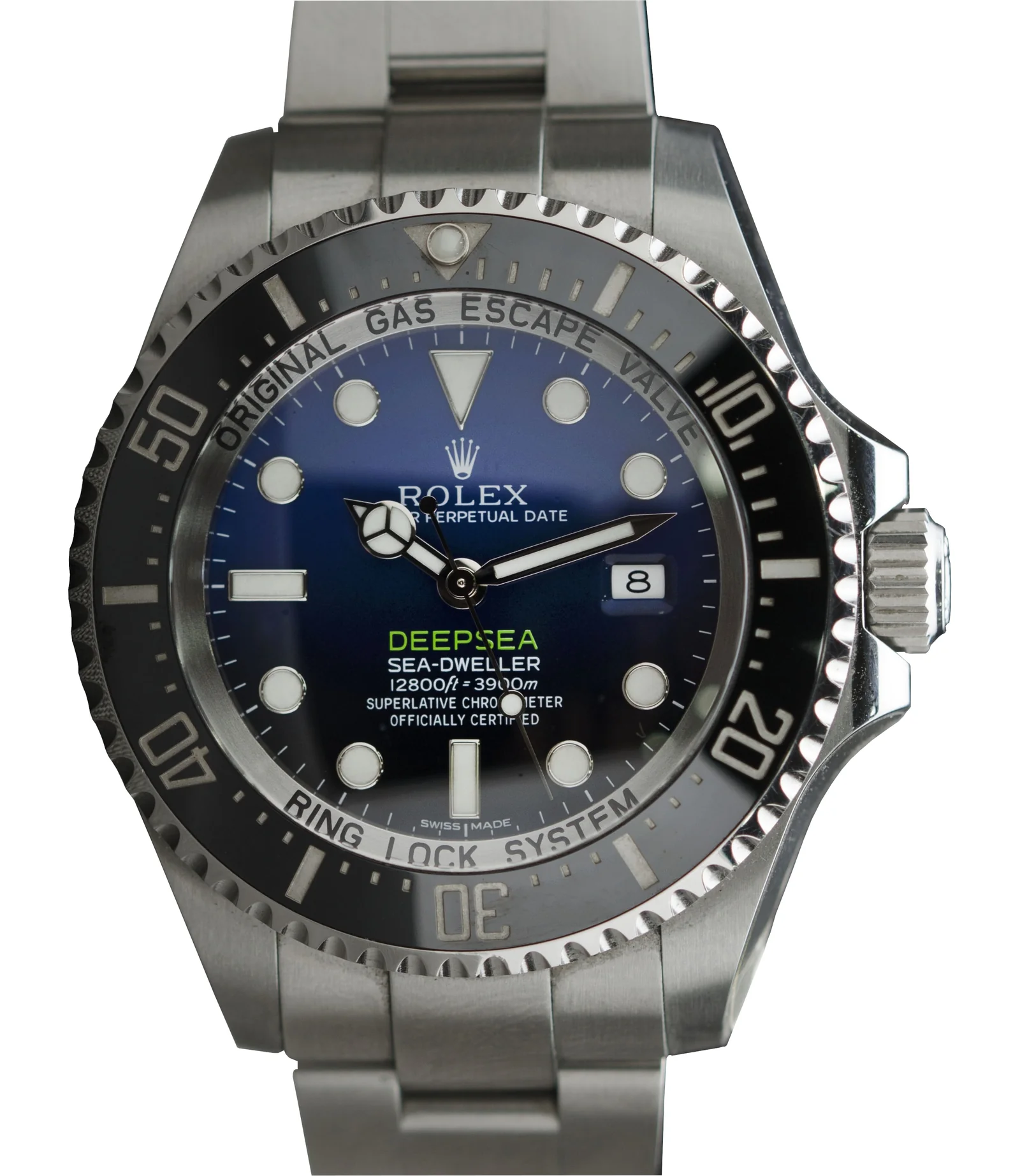 D-blue front view, original photograph by amh1988; upright derivative by Pittigrilli, CC0 1.0
-
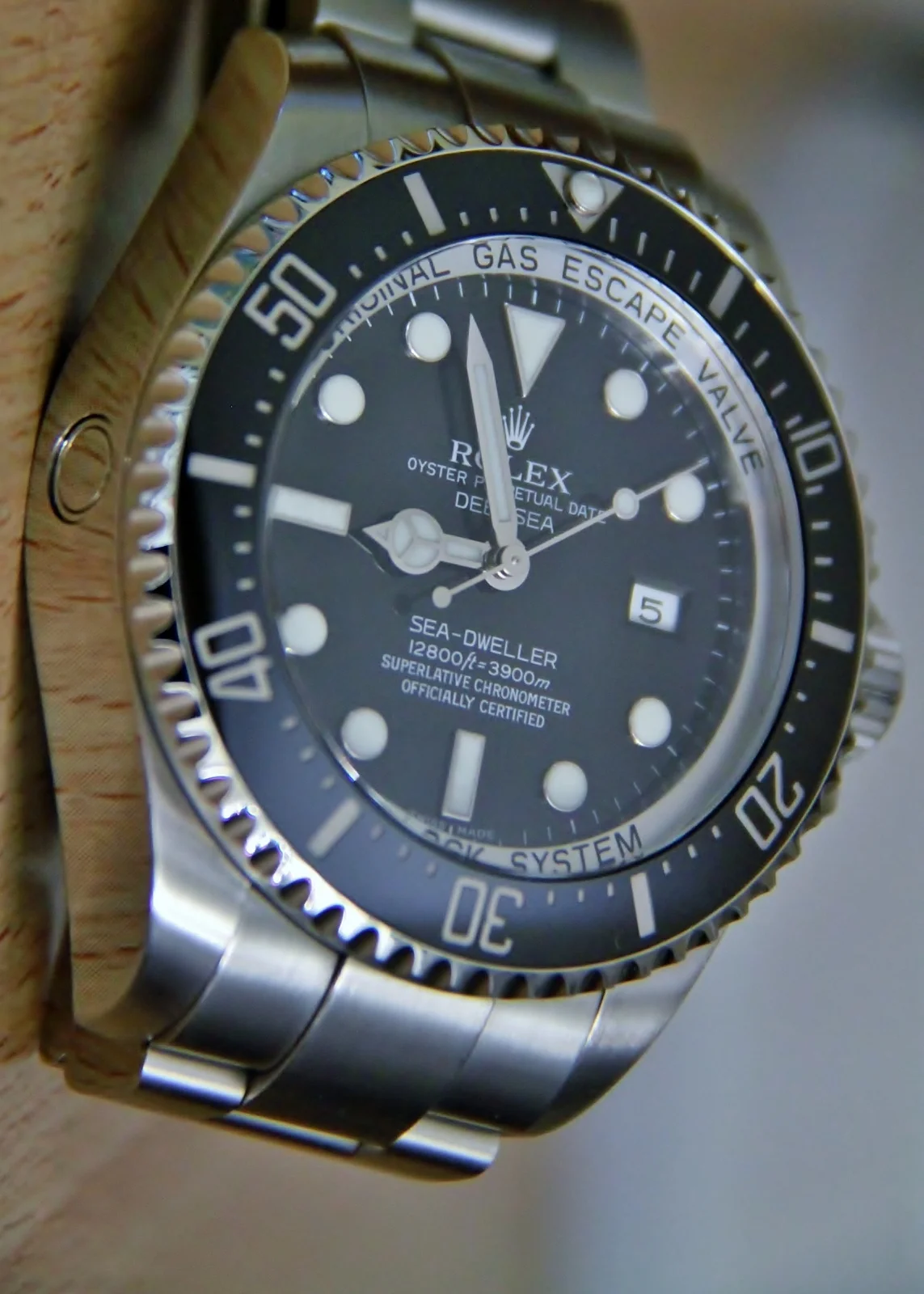 Black dial, John Torcasio, CC BY-SA 3.0; rotated clockwise and converted to WebP, shared under the same license
Sources
- Rolex, "Rolex Deepsea technical brochure, April 2013", Rolex (PDF reproduced by The Watch), 2013-04
- Rolex, "The Rolex Deepsea Challenge press kit — technical comparison with the commercial Deepsea", Rolex Newsroom, 2020
- Rolex, "Deepsea — Journey to the deep", Rolex
- Rolex, "The Rolex Deepsea Models", Rolex Newsroom
- Rolex, "A new generation Oyster Perpetual Sea-Dweller 4000", Rolex; archived transcription at Watch-Wiki, 2014-03-26
- James Stacey, "Introducing: The Rolex Deepsea Ref. 126660", HODINKEE, 2018-03-22
- Robert-Jan Broer, "The New Rolex Deepsea Sea-Dweller Reference 126660", Fratello Watches, 2018-03-23
- "Reference 116660 Deepsea Sea-Dweller, circa 2008", Sotheby's
- "Deepsea ref. 116660, case V244796, circa 2009", Bonhams, 2022-12
- "Deepsea ref. 116660, case G172288, guarantee dated 2012", Christie's, 2018-11-12
- "D-blue Deepsea ref. 116660, guarantee dated 2014", Sotheby's
- Rolex, "Rolex US price list, June 2012", Rolex (PDF reproduced by The Watch), 2012-06
- Sotheby's Watches Department, "Royal Navy Clearance Diver Deepsea Sea-Dweller, no. 33/50", Sotheby's, 2021-09-16
- Phillips Watches Department, "Royal Navy Clearance Branch Deepsea, no. 38/50", Phillips, 2023-11
- Christie's Watches Department, "Royal Navy Clearance Diver 116660, edition 36/50", Christie's, 2024-05-13
- Christie's Watches Department, "Deep Blue DLC-coated 116660, no. 12/50", Christie's, 2016-11-28
- "DSSD owners thread and black-dial comparison discussion", Rolex Forums, 2024-01
- SPACE-DWELLER, "Rolex dial printing variations revisited: Deepsea 116660", Rolex Forums, 2012-08-31
- Hiroyuki Ikeda, "Rolex Deepsea 116660 dial and clasp changes", GINZA RASIN, 2017-11-20
- Monochrome Watches Editorial, "In-Depth: The History of the Rolex Sea-Dweller", Monochrome Watches, 2025
- "Rolex Deepsea Sea-Dweller 116660 Blue Dial", Wikimedia Commons; original by amh1988 / Pixabay, 2017-02-08
- "Rolex Deepsea Oyster Perpetual reference 116660", Wikimedia Commons; John Torcasio, 2011-02-05

