
Rolex Prince Imperial 1586
Prince → 1586

The Prince Imperial ref. 1586 is an open-face pocket watch with an irregular hexagonal case and a separate seconds dial. Catalogues document 9K and 18K white-gold examples, plus a yellow-gold watch with an Astrua-signed dial.[1][2][3][4]
Core facts
| Detail | Documented description |
|---|---|
| Family | Prince Imperial pocket watch |
| Dating | A Glasgow import mark on case 1003410 is dated 1931–32. Catalogues date other examples around 1940 or in the 1940s. |
| Winding and display | Manual winding; hours and minutes on the main dial, with seconds in a separate register |
| Movement | Lot-level descriptions include 15-line Observatory and Ultra Prima movements, a Cal. 800 attribution, and a 37-jewel Observatory description. The catalogues describe several movement types, but the records do not establish a shared caliber or standard specification for the reference. |
| Case | Irregular hexagonal, open-face case; pendant ring at the upper-right corner in documented examples; around 41 × 37 mm in several catalogues |
| Materials | 9K white gold, 18K white gold, and yellow gold are documented in individual listings. |
Where it sits in the line
The Vintage Rolex Field Manual's reference table lists ref. 1645 as a Prince Imperial pocket watch and ref. 1585 as a purse watch. Auction catalogues identify ref. 1586 as another Prince Imperial pocket watch.[5][1][6]
Production outline
The surviving catalogue dates are specimen-level evidence. Antiquorum reports Glasgow import marks dated 1931–32 on case 1003410; the same case and movement numbers appear in the house’s 2014 and 2015 listings. Antiquorum dates case 1003377 to a Glasgow import mark of 1931 in its 2008 Bonhams archive transcription. Those marks date the cases, not the watches’ manufacture or delivery.[1][7][8]
Catalogues date separate examples to around 1940 or broadly to the 1940s. Cambi gives a ’30/’40 estimate for case 1003414. The catalogue dates apply to individual watches; they do not establish when production began or ended.[2][9][6][3][4]
Movement notes
The movement descriptions differ from lot to lot. These figures belong to the watches listed below and remain lot-level descriptions.
| Example | Catalogue description |
|---|---|
| Case 1003410; Antiquorum 2014 and 2015 | 15-line Observatory, 17 jewels, adjusted to eight positions. Both listings refer to the same watch. |
| Case 1003377; Bonhams 2008 archive transcription | 17-jewel Observatory-quality manual movement, timed to six positions; movement no. 1000183. |
| Case 1003372; Antiquorum 2021, 2022 and 2023 | 15-line, 17-jewel Observatory movement; the 2023 catalogue specifies six positions. The three appearances are one watch. |
| Case 1834; Sotheby's Geneva 2009 | 17-jewel manual Observatory-quality movement, timed to six positions. Sotheby's Hong Kong 2014 archive lists the same case number; repeat identity is likely but unconfirmed.[10][11] |
| Case not reported; Sotheby's New York 2011 | 17-jewel Observatory-quality movement with a Rolex patent cap; the catalogue does not give a movement caliber or serial.[12] |
| Case 1003414; Cambi 2022 | Movement no. 1000317. The catalogue leaves the caliber field blank; the photograph shows “ROLEX OBSERVATORY,” “TIMED 6 POSITIONS” and “17 RUBIES.” |
| Case 1008587; Antiquorum 2008 archive transcription | 15-line, 17-jewel Ultra Prima, adjusted to six positions; movement no. 1001051. |
| Case 1003411; Jones & Horan 2024, lot 169 | The movement photograph shows “17 Rubies” and “In Eight Ways.” The catalogue describes a 17-jewel lever movement and gives no caliber. |
| Antiquorum 2001, lot 115 | The catalogue assigns Cal. 800, 16.5 lignes and 17 jewels to its black-dial example. |
| Christie’s archived lot 782291 | The catalogue describes a 17-jewel Ultra Prima movement timed to six positions. It prints the back-mark string 1586/8753/947742 without mapping each number to a component. |
| Christie’s Dubai, sale 23035, lot 80 | A 37-jewel manual Observatory movement is listed, with no caliber named. |
These descriptions, like the 15-line and 16.5-line measurements, caliber name, jewel counts and adjustment figures elsewhere in the table, belong to their respective catalogue entries; they do not establish one movement specification for the reference. Jones & Horan’s movement photograph adds a visible 17-rubies marking and an eight-way adjustment inscription on case 1003411; its catalogue text names no caliber.[1][7][8][2][13][9][3][14][15][6][16]
Dial map
| Dial description | Identified example |
|---|---|
| Silver dial with an eccentric time display, baton indexes, outer minute track and subsidiary seconds | Case 1003410, Antiquorum 2014/2015 |
| Silvered dial with Arabic quarters, baton hour markers and subsidiary seconds | Case 1003377, Bonhams 2008 archive transcription |
| Two-tone dial with subsidiary seconds | Case 1003372, Antiquorum 2021/2022/2023 |
| Silver dial with baguette-diamond indexes, baton hands and separate seconds | Case 1003414 |
| Black dial with Arabic quarters, baton markers and subsidiary seconds | Antiquorum 2001, lot 115; the lot’s case number is not reported |
| Black dial with Arabic quarter-hour numerals and gilt baton indexes | Case 1008587 |
| Silvered two-tone dial | Case F1826, Christie’s Dubai, sale 23035, lot 80 |
| Silvered dial with diamond markers and baguette quarters | Christie’s archived listing; its caseback number string is not component-mapped |
| Silvered dial with subsidiary seconds | Case 1834, Sotheby's Geneva 2009 |
| Two-tone silvered dial | Case number not reported, Sotheby's New York 2011 |
| Silvered dial with upper hours-and-minutes display and lower seconds register | Case 1003411, Jones & Horan 2024, lot 169.[16] |
-
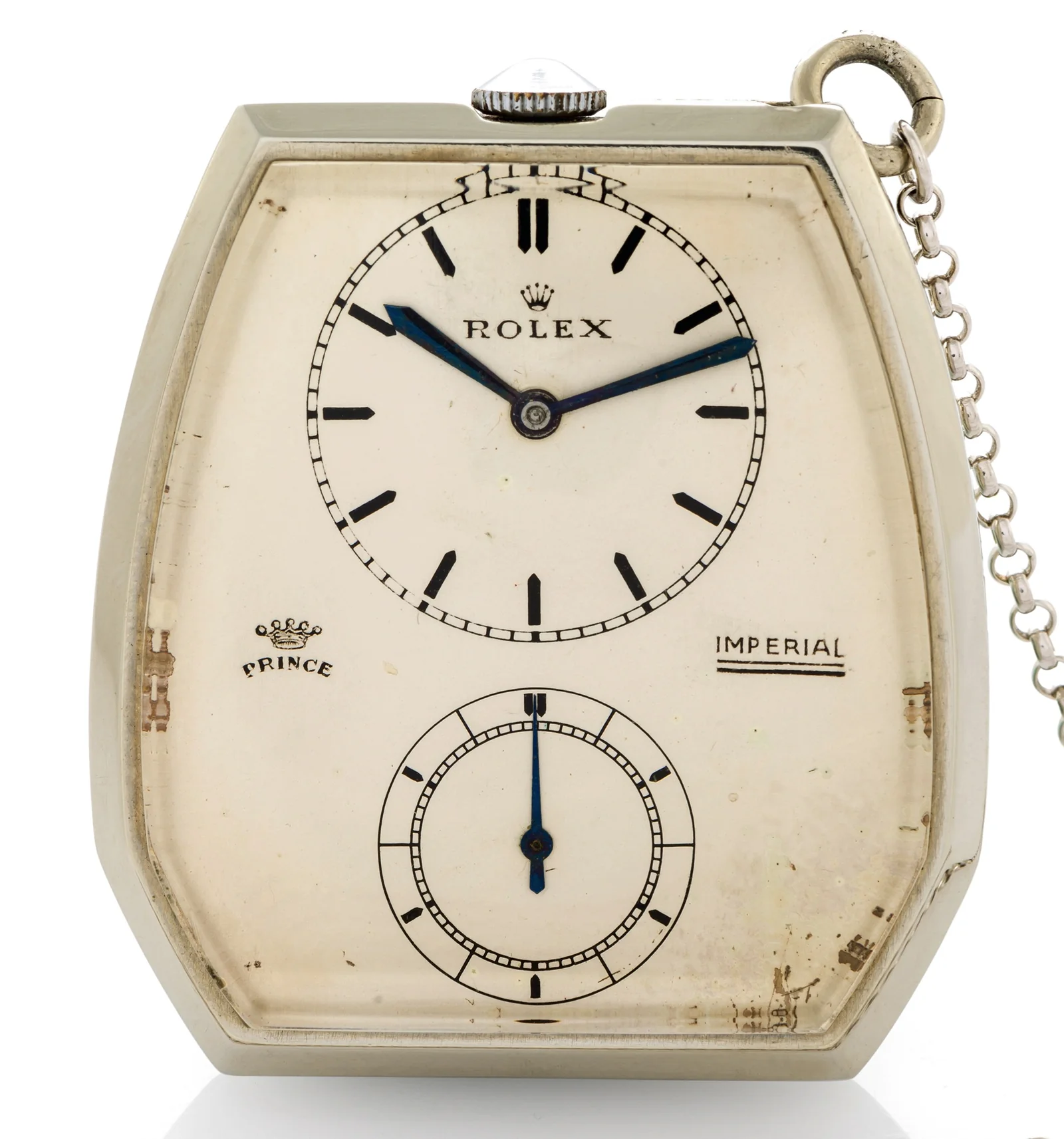 Case 1003410, silver eccentric dial; Antiquorum, 2014, lot 630.
-
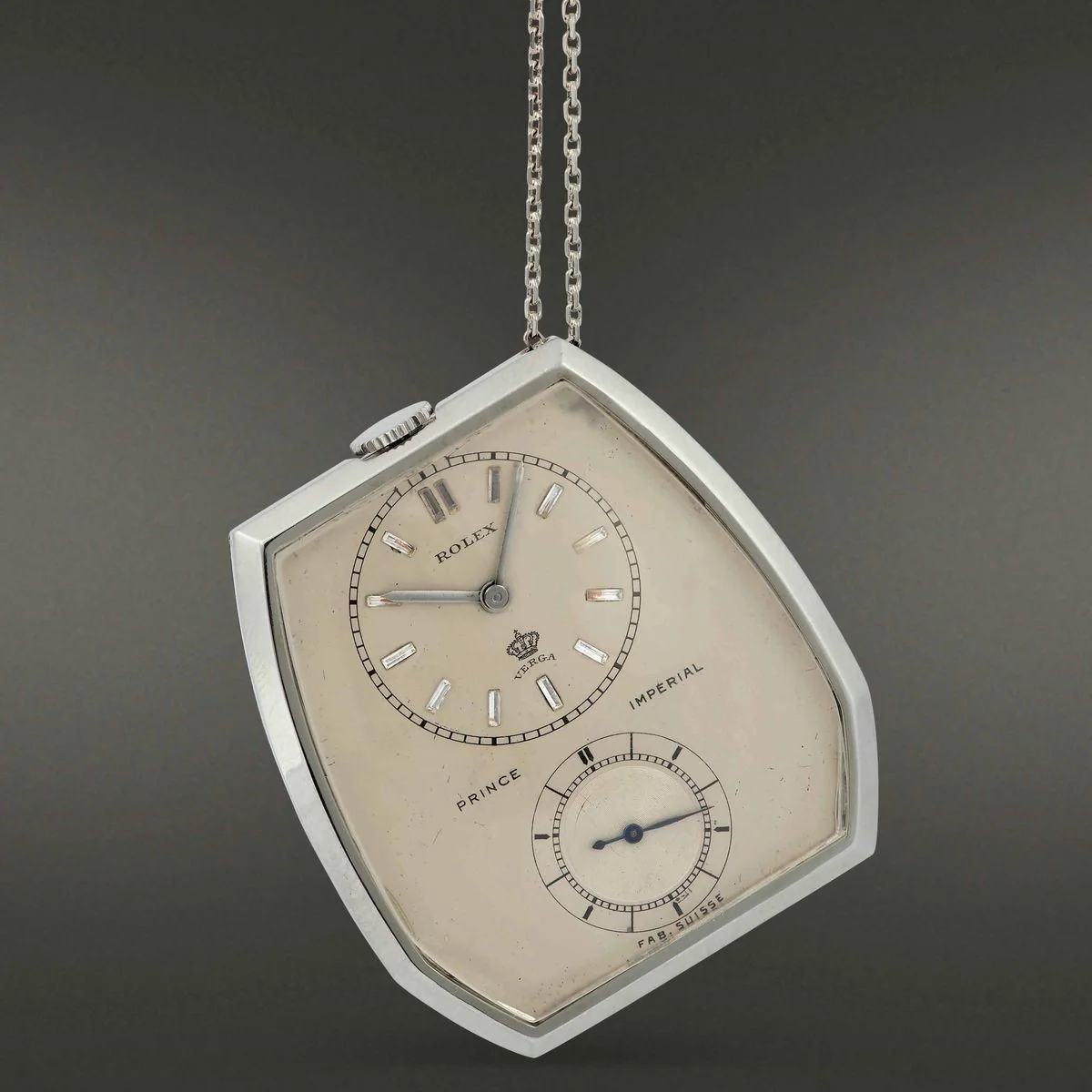 Case 1003414, Verga Milano dial with baguette-diamond indexes; Cambi, 2022, lot 15.


Case, bezel, crystal, and crown
The listed cases are irregular hexagons with the pendant ring at the upper-right corner. Antiquorum describes a polished two-body case for 1003410; Cambi describes case 1003414 as a two-piece case with a snap-on back. Christie’s gives 40.5 × 37.3 mm for case F1826, while several other catalogues give 41 × 37 mm. Measuring points vary or go unstated, so the small difference does not establish a change during production. Jones & Horan’s caseback photograph shows 1003411 above the reference stamp 1586. Its catalogue lists an 18K white-gold case and gives the same 41 × 37 mm dimensions found in several other listings.[1][3][6][15][16]
The documented metals include 9K white gold on case 1003372, 18K white gold on cases 1003410 and 1003414 and Christie’s case F1826, and yellow gold on Antiquorum’s Astrua-signed case 1008587. Sotheby’s 2009 Geneva catalogue describes case 1834 as an 18K white-gold ref. 1586; its 2014 Hong Kong archive entry gives the same case number. The shared number suggests a repeat appearance, though the available records do not confirm it by movement number or image comparison.[2][1][3][6][4][10][11]
Bracelets, end links, clasps, and packaging
These listings concern pocket watches. They record chains with cases 1003410, 1003414 and 1003372. Cambi identifies the 1003414 chain as personalized by Verga Milano. Antiquorum lists a fitted box with case 1003372 and calls it original in the 2023 catalogue. Accessory fitment varies by watch; the records do not establish a standard delivery set for the reference.[1][3][2][9]

Special branches
| Retailer signature | Documented example |
|---|---|
| Verga Milano | Case 1003414, silver dial with baguette-diamond indexes; Cambi also describes the chain as personalized by Verga Milano. |
| Astrua, Torino | Yellow-gold case 1008587, black dial with Arabic quarters and gilt baton markers. |
| Serpico y Laino | Christie’s archived listing describes a silvered dial with diamond markers and baguette quarters. Its caseback number string is not mapped by component. |
The retailer signatures are recorded at lot level; the catalogues leave their dates and fitting histories unspecified.[3][4][15]
Historical market and auction record
| Sale | Identified watch | Record |
|---|---|---|
| Antiquorum, New York, 25 April 2001, lot 115 | Black-dial 1586; case and movement numbers not given | Estimate USD 2,000–2,500; result not shown in the catalogue record. |
| Antiquorum, Hong Kong, 8 June 2008, lot 282 | Yellow-gold case 1008587, movement 1001051 | Archived catalogue transcription; result not shown. |
| Bonhams, London, 11 June 2008, lot 82 | 9ct white-gold case 1003377, movement 1000183 | Archived catalogue transcription reports a result of £1,020. |
| Sotheby’s, Geneva, 15 November 2009, lot 125 | 18K white-gold case 1834 | Circa-1945 catalogue date; estimate CHF 6,000–8,000. The shared case number links it probably, but not conclusively, to the 2014 Hong Kong entry.[10] |
| Sotheby’s, New York, 13 April 2011, lot 58 | Case and movement numbers not reported | Circa 1940; estimate USD 5,000–7,000. Result not available in the listing.[12] |
| Sotheby’s, Hong Kong, 8 April 2014, lot 2310 | Same case number 1834 | Archived entry gives a circa-1945 description, HKD 40,000–55,000 estimate and unsold status; likely repeat of the 2009 case.[11] |
| Antiquorum, Geneva, 8 November 2014, lot 630 | Case 1003410, movement 1000884 | Estimate CHF 5,000–8,000; result not shown. |
| Antiquorum, Geneva, 8 November 2015, lot 276 | Same case 1003410 / movement 1000884 | Sold for CHF 4,375. This is a repeat sale, not a second specimen. |
| Antiquorum, Hong Kong, 5 December 2021, lot 174 | Case 1003372, movement 1000174 | Sold for HKD 43,750. |
| Cambi, 17 September 2022, lot 15 | Case 1003414, movement 1000317 | Estimate €1,500–3,000; result not shown on the listing. |
| Antiquorum, Geneva, 5 November 2022, lot 98 | Same case 1003372 / movement 1000174 | Estimate CHF 4,000–8,000; result not shown. |
| Antiquorum, Geneva, 4 November 2023, lot 128 | Same case 1003372 / movement 1000174 | Sold for CHF 3,250. This is the third listing of that watch in the cited records. |
| Christie’s Dubai, sale 23035, lot 80 | White-gold case F1826, movement 1,000,947 | Christie’s reports USD 6,930 including buyer’s premium, against an estimate of USD 5,000–8,000; the sale closed on 30 April 2024.[17] |
| Jones & Horan, 10 October 2024, lot 169 | Case 1003411, ref. 1586 stamped inside caseback | 18K white gold; 41 × 37 mm; estimate USD 2,000–4,000. The catalogue gives movement serial 1000882 without identifying the component. |
| Christie’s archived lot 782291 | Serpico y Laino-signed dial; back-mark string 1586/8753/947742 | Archived catalogue describes a 17-jewel Ultra Prima; sale date and result are not given in the available entry. |
The two confirmed repeat-sale groups account for five catalogue appearances but only two watches: case 1003410 in 2014 and 2015, and case 1003372 in 2021, 2022 and 2023. Sotheby’s 2009 and 2014 entries share case number 1834 and probably refer to one watch, but the available records do not confirm the match. Jones & Horan’s case 1003411 is separately numbered. The reported results use different currencies, sale dates and condition descriptions, so they do not form a price series.[14][1][7][2][13][3][9][8][4][10][11][12][6][17][15][16]
Related references
- Ref. 1645 — another Prince Imperial pocket watch, with a distinct set of catalogued case and movement examples.
- Prince family index
- Movements and Serial numbers
- ↑ 1.0 1.1 1.2 1.3 1.4 1.5 1.6 1.7 Antiquorum, Geneva, 8 November 2014, lot 630
- ↑ 2.0 2.1 2.2 2.3 2.4 2.5 Antiquorum, Hong Kong, 5 December 2021, lot 174
- ↑ 3.0 3.1 3.2 3.3 3.4 3.5 3.6 3.7 Cambi Casa d'Aste, 17 September 2022, lot 15
- ↑ 4.0 4.1 4.2 4.3 4.4 Antiquorum Hong Kong, 8 June 2008, lot 282, archived transcription
- ↑ Colin A. White, The Vintage Rolex Field Manual, “Prince, Princess & Queen References”
- ↑ 6.0 6.1 6.2 6.3 6.4 6.5 Christie's Dubai, sale 23035, lot 80
- ↑ 7.0 7.1 7.2 Antiquorum, Geneva, 8 November 2015, lot 276
- ↑ 8.0 8.1 8.2 Bonhams London, 11 June 2008, lot 82, archived transcription
- ↑ 9.0 9.1 9.2 9.3 Antiquorum, Geneva, 4 November 2023, lot 128
- ↑ 10.0 10.1 10.2 10.3 Sotheby's Geneva, 15 November 2009, lot 125
- ↑ 11.0 11.1 11.2 11.3 Sotheby's Hong Kong, 8 April 2014, lot 2310, archived transcription
- ↑ 12.0 12.1 12.2 Sotheby's New York, 13 April 2011, lot 58
- ↑ 13.0 13.1 Antiquorum, Geneva, 5 November 2022, lot 98
- ↑ 14.0 14.1 Antiquorum, New York, 25 April 2001, lot 115
- ↑ 15.0 15.1 15.2 15.3 Christie's, archived lot 782291
- ↑ 16.0 16.1 16.2 16.3 Jones & Horan, 10 October 2024, lot 169
- ↑ 17.0 17.1 Christie’s official sale results
Gallery
-
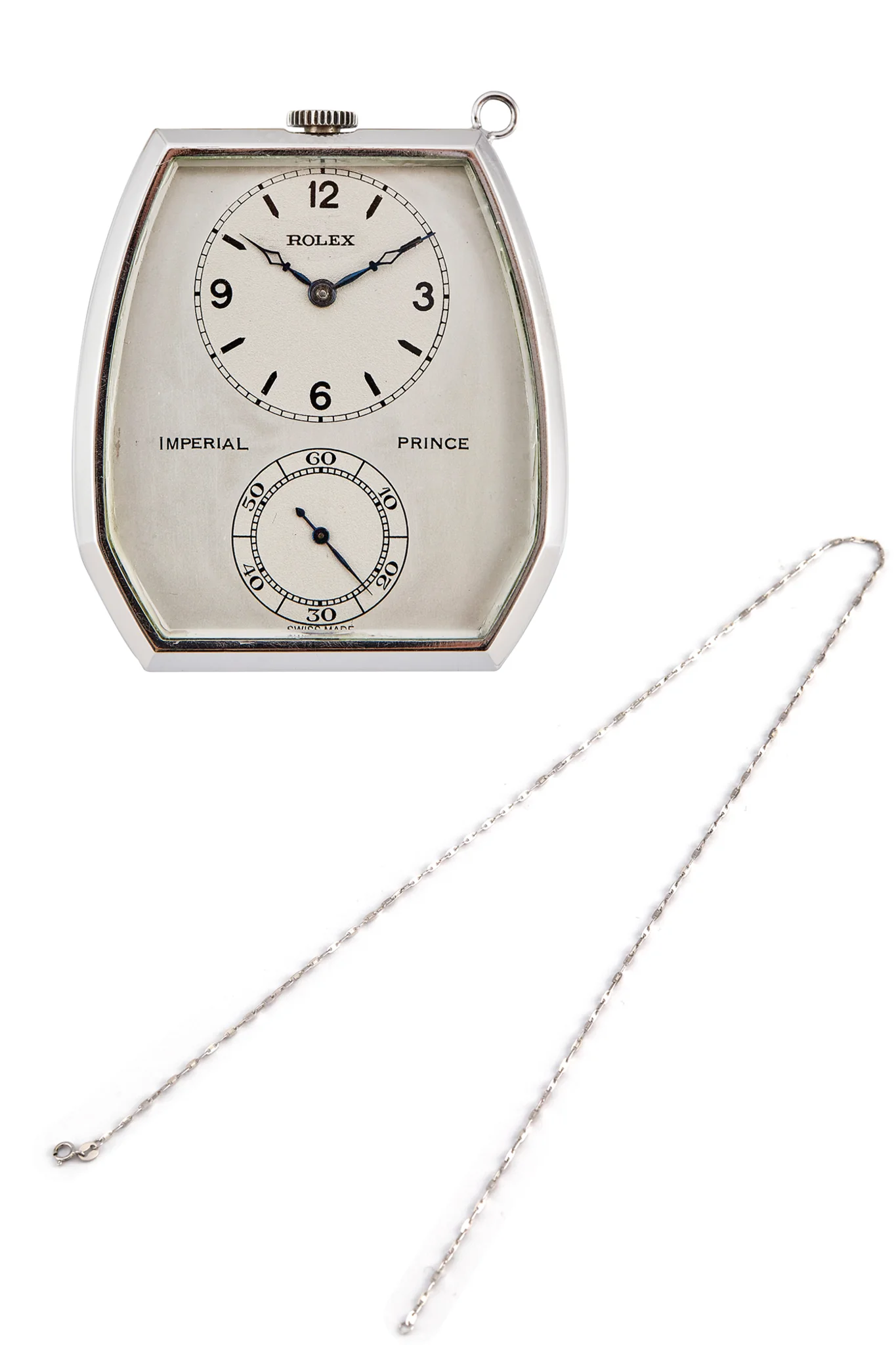 Case 1003372, 9K white gold; Antiquorum, Hong Kong, 2021, lot 174.
-
Case 1003410, silver eccentric dial; Antiquorum, Geneva, 2014, lot 630.
-
Case 1003414, Verga Milano dial; Cambi, 2022, lot 15.
-
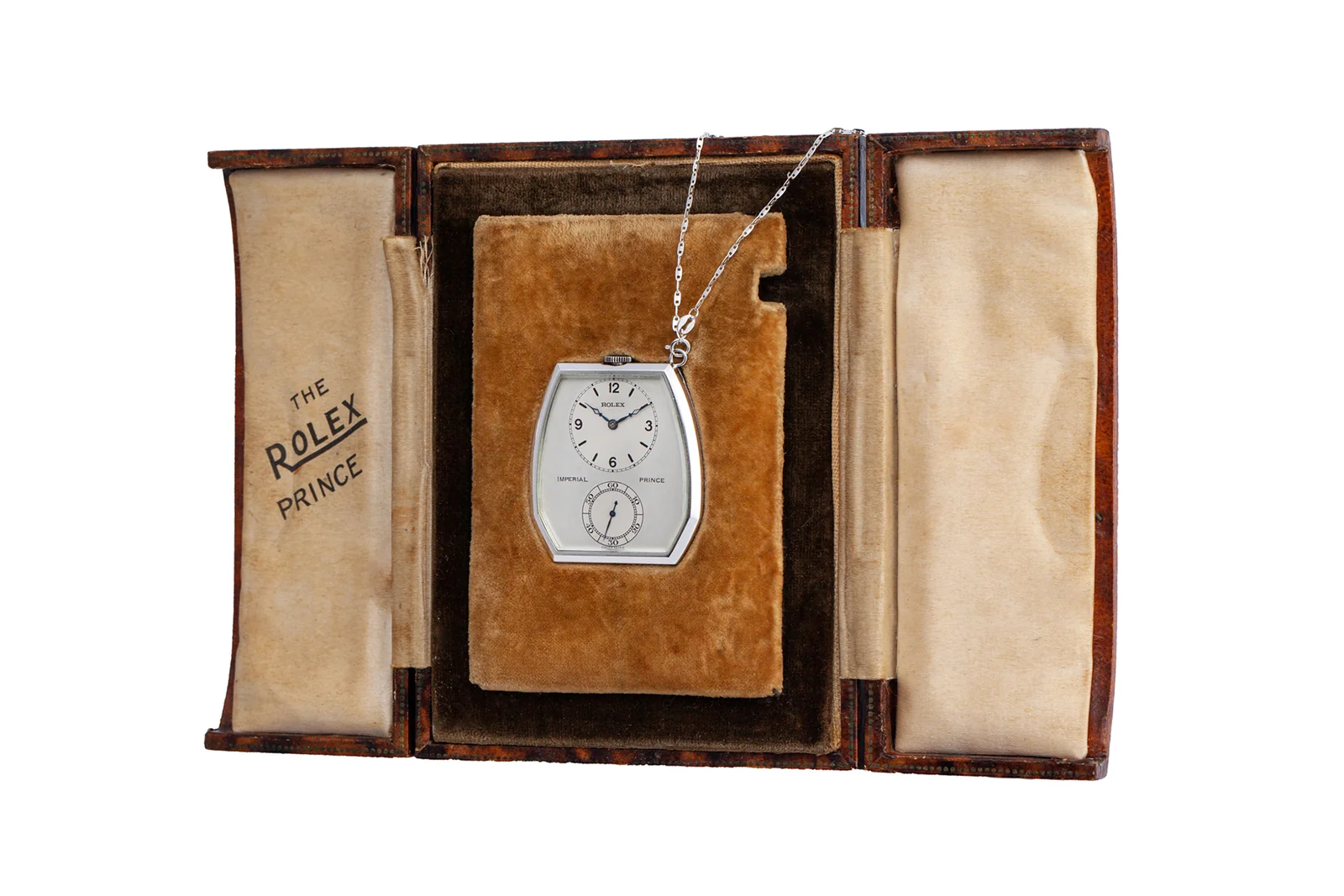 Case 1003372 with chain and fitted box; Antiquorum, 2021, lot 174.
Sources
- Antiquorum, "Antiquorum Geneva, 8 November 2014, lot 630 — Rolex Prince Imperial ref. 1586, case 1003410", Antiquorum, 2014-11-08
- Antiquorum, "Antiquorum Geneva, 8 November 2015, lot 276 — Rolex Prince Imperial ref. 1586, case 1003410", Antiquorum, 2015-11-08
- Antiquorum, "Antiquorum New York, 25 April 2001, lot 115 — Rolex Prince Imperial ref. 1586", Antiquorum, 2001-04-25
- Antiquorum, "Antiquorum Hong Kong, 5 December 2021, lot 174 — Rolex Imperial Prince ref. 1586, case 1003372", Antiquorum, 2021-12-05
- Antiquorum, "Antiquorum Geneva, 5 November 2022, lot 98 — Rolex Imperial Prince ref. 1586, case 1003372", Antiquorum, 2022-11-05
- Antiquorum, "Antiquorum Geneva, 4 November 2023, lot 128 — Rolex Prince Imperial ref. 1586, case 1003372", Antiquorum, 2023-11-04
- Antiquorum, "Antiquorum Hong Kong, 8 June 2008, lot 282 — Rolex Prince Imperial ref. 1586, case 1008587 (archived listing)", Antiquorum; archived transcription at Collector Square, 2008-06-08
- Bonhams, "Bonhams London, 11 June 2008, lot 82 — Rolex Prince Imperial ref. 1586, case 1003377 (archived listing)", Bonhams; archived transcription at Collector Square, 2008-06-11
- Sotheby's, "Sotheby's Hong Kong, 8 April 2014, lot 2310 — Rolex Prince Imperial ref. 1586, case 1834 (archived listing)", Sotheby's; archived transcription at Collector Square, 2014-04-08
- Cambi Casa d’Aste, "Cambi, 2022, lot 15 — Rolex Prince Imperial ref. 1586, case 1003414", Cambi Casa d’Aste
- Christie’s, "Christie’s Dubai, sale 23035, lot 80 — Rolex Prince ref. 1586, case F 1826", Christie’s
- Christie's, "Christie's archived lot 782291 — Rolex Prince Imperial ref. 1586", Christie's
- The Vintage Rolex Field Manual — Colin A. White, Morning Tundra
- Jones & Horan Auction Team, "Jones & Horan, 10 October 2024, lot 169 — Rolex Prince Imperial, case 1003411", Jones & Horan Auction Team, 2024-10-10
- Christie’s, "Christie’s Watches Online: The Dubai Edit, sale 23035 results", Christie’s, 2024-04-30
- Sotheby's, "Sotheby's Geneva, 15 November 2009, lot 125 — Rolex Prince Imperial ref. 1586, case 1834", Sotheby's, 2009-11-15
- Sotheby's, "Sotheby's New York, 13 April 2011, lot 58 — Rolex Prince Imperial ref. 1586", Sotheby's, 2011-04-13