
Rolex Datejust Turn-O-Graph 1625
Datejust → 1625

Ref. 1625 is a Datejust with a bidirectional, 60-minute Turn-O-Graph bezel.
Core facts
| detail | value |
|---|---|
| reference | 1625 |
| line | Datejust Turn-O-Graph; auction catalogues also use “Thunderbird” |
| documented dates | Case-numbered auction examples dated circa 1960–1974; published production range often given as 1959–1977 |
| case | Usually catalogued at 35 or 36 mm; measurements vary by lot |
| materials | Case-numbered examples in steel with yellow- or white-gold bezel, solid yellow gold, and pink gold |
| movement | Rolex parts catalogues list date works for Cal. 1565 and Cal. 1575 in case ref. 1625; the transition year remains undated |
| bezel | Bidirectional, graduated and reeded or engine-turned; auction lots describe yellow or white gold |
| crystal | Fratello describes acrylic on one circa-1974 example; fitment across the reference remains unresolved |
| bracelets | Jubilee and riveted Oyster examples appear in catalogues; original delivery is watch-specific |
Where it sits in the line
Antiquorum quotes Rolex’s 1965 catalogue as calling ref. 1625 the “Datejust, Turn-O-Graph.” The watch combines the date and Cyclops lens of a Datejust with a rotating timing bezel. Sotheby’s 2020 catalogue calls one example a “Thunderbird Datejust,” and Rolex Forums collectors use both names. This records the nickname in auction and owner usage; no specific squadron-issued 1625 is identified. Antiquorum, lot 76 Sotheby's Rolex Forums discussion
Production outline
Fratello, Amsterdam Watch Company, and Swiss Watch Club give a broad production span of 1959–1977. Auction records document individual watches dated circa 1960, 1964, 1965, 1967, 1971 and 1974. The catalogue dates attach to those individual watches. The sources reviewed here do not give a factory production endpoint. Fratello Amsterdam Watch Company Swiss Watch Club
Movement notes
Rolex’s Cal. 1565 parts catalogue lists calendar ring 8023 for case ref. 1625 and labels automatic-device bridge parts 1560. An EmmyWatch Cal. 1565 compilation lists date-indicator seating 7964 for ref. 1625. Rolex’s Cal. 1575 parts catalogue lists the same seating for ref. 1625 and marks its automatic-device bridge 1570. The records document listed parts and bridge markings. Inspect a watch’s movement to identify its caliber; the catalogues do not date the changeover.
Auction catalogues list 1625 examples as Cal. 1560 or 1570. Antiquorum’s 2006 record for a 1971 watch says the movement is stamped 1570, then identifies the date calibre as 1575, citing Osvaldo Patrizzi. A collector-maintained timeline on r/rolex places the 1565-to-1575 change around 1965, but does not tie that estimate to a serial-backed movement sequence. Inspect an individual movement to identify the caliber fitted. r/rolex timeline
Dial map
The catalogued examples show black gilt, black, silver, champagne, grey, pink and grey linen dials. Phillips describes its circa-1965 black dial as gilt; Sotheby’s records a champagne dial circa 1971; Christie's describes a pink brushed dial on a pink-gold watch circa 1967. Antiquorum lists a grey dial on its white-gold example and a grey linen dial on a circa-1974 steel watch. The catalogues document individual dials rather than a complete factory range. Phillips Sotheby's Christie's Antiquorum

Case, bezel, crystal, and crown
Auction records show the reference in steel with yellow- or white-gold bezel, as well as solid yellow-gold and pink-gold examples. These lots document individual configurations. The sources reviewed here do not enumerate the factory option range or its frequency. Most listed diameters are 36 mm; Phillips and Christie's list 35 mm for their examples. Antiquorum's 18k yellow-gold example Christie's pink-gold example
The bezel rotates in both directions and carries a 60-minute scale. Antiquorum describes reeded and graduated 18k white-gold bezels on two steel examples; Fratello describes the friction fit on a circa-1974 yellow-gold watch. Bezel metal should be checked on the specific case.
Fratello describes a screw-down crown and acrylic crystal on its circa-1974 example. Auction records also describe screw-down cases and crowns. The sources reviewed here do not show a run-wide crystal or crown transition.
-
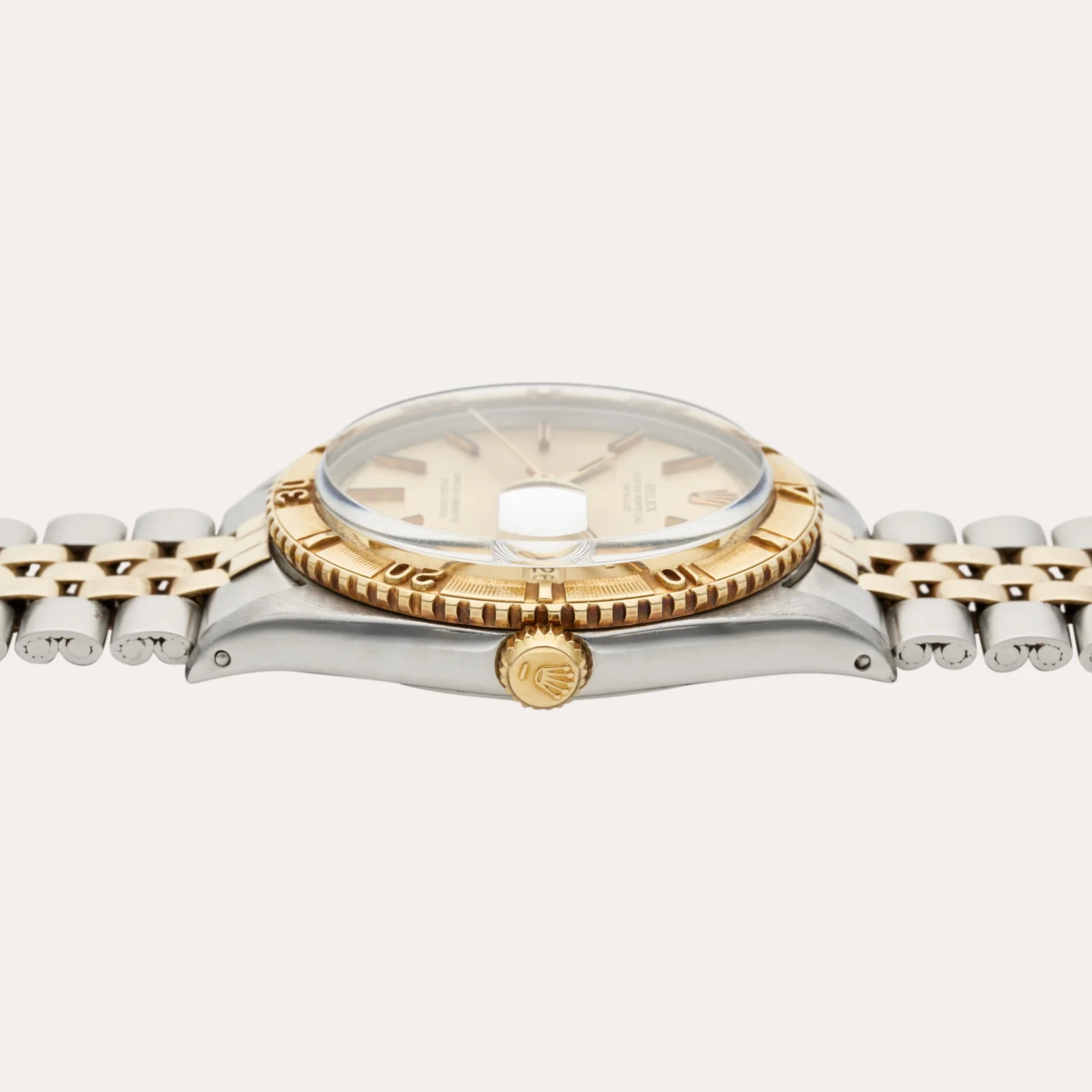 Case, crown, and bezel profile
-
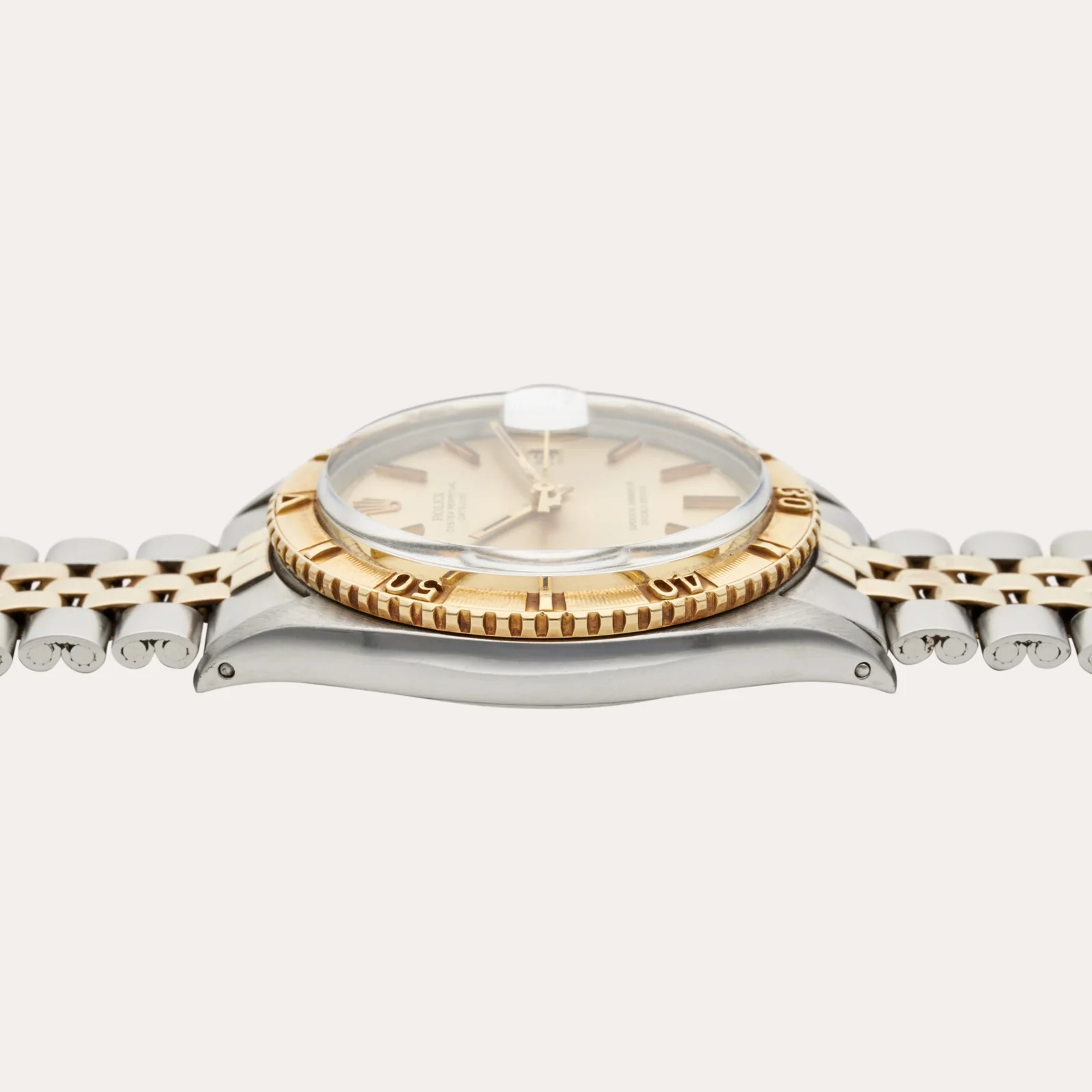 Side profile of the case and bezel


Bracelet, clasp, and packaging
Jubilee bracelets appear on multiple auction examples, including the Sotheby’s circa-1971 watch shown here. Christie's records a riveted Oyster bracelet on its circa-1967 pink-gold example. The Phillips circa-1965 watch was catalogued on leather. These listings record sale-time configurations. Establishing original delivery requires evidence from each watch.

The Sotheby’s photographs show end links stamped 255 on this Jubilee bracelet. The mark identifies a component on this watch; the published examples do not establish fitment across the reference. The listing photographs show the caseback and end links, while the clasp interior is outside the image set.
Special branches
Hodinkee’s 2019 “Bring a Loupe” feature documents a circa-1970 ref. 1625 with a Joyería Riviera retailer signature on the dial. The article identifies Riviera as a Havana retailer that later moved to San Juan. This is one documented signed example. Hodinkee gives no production count or first-sale record. Hodinkee
Auction record
| date assigned by catalogue | case number | recorded configuration | source |
|---|---|---|---|
| circa 1960 | 538,990 | steel and yellow gold; 36 mm; Cal. 1560 in catalogue | Antiquorum, Geneva, lot 185 (2023) |
| circa 1964 | 1,065,591 | steel with white-gold bezel; black dial; 35 mm; Cal. 1560 in catalogue | Sotheby's, Important Watches (2020) |
| circa 1965 | 1,273,079 | steel and yellow gold; black gilt dial; 36 mm; Cal. 1560 in catalogue | Phillips, Hong Kong Watch Auction XVI, lot 1003 |
| circa 1967 | 1,556,624 | pink gold; pink brushed dial; 35 mm; riveted Oyster bracelet | Christie's, lot 5804918 (2014) |
| circa 1971 | 2,754,615 | steel and yellow gold; champagne dial; Jubilee bracelet; Cal. 1570 in catalogue | Sotheby's, Fine Watches (2024) |
| circa 1974 | 3,801,682 | steel; grey linen dial; Jubilee bracelet; Cal. 1570 in catalogue | Antiquorum, Geneva, lot 285 (2024) |
| date not stated | 2,793,138 | 18k yellow gold; Cal. 1570 in catalogue | Antiquorum, Geneva, lot 397 (2023) |
Catalogue caliber labels in this table follow the listing. The Rolex parts sheets clarify that 1560 and 1570 can be bridge engravings on the date-equipped 1565 and 1575 movements.
-
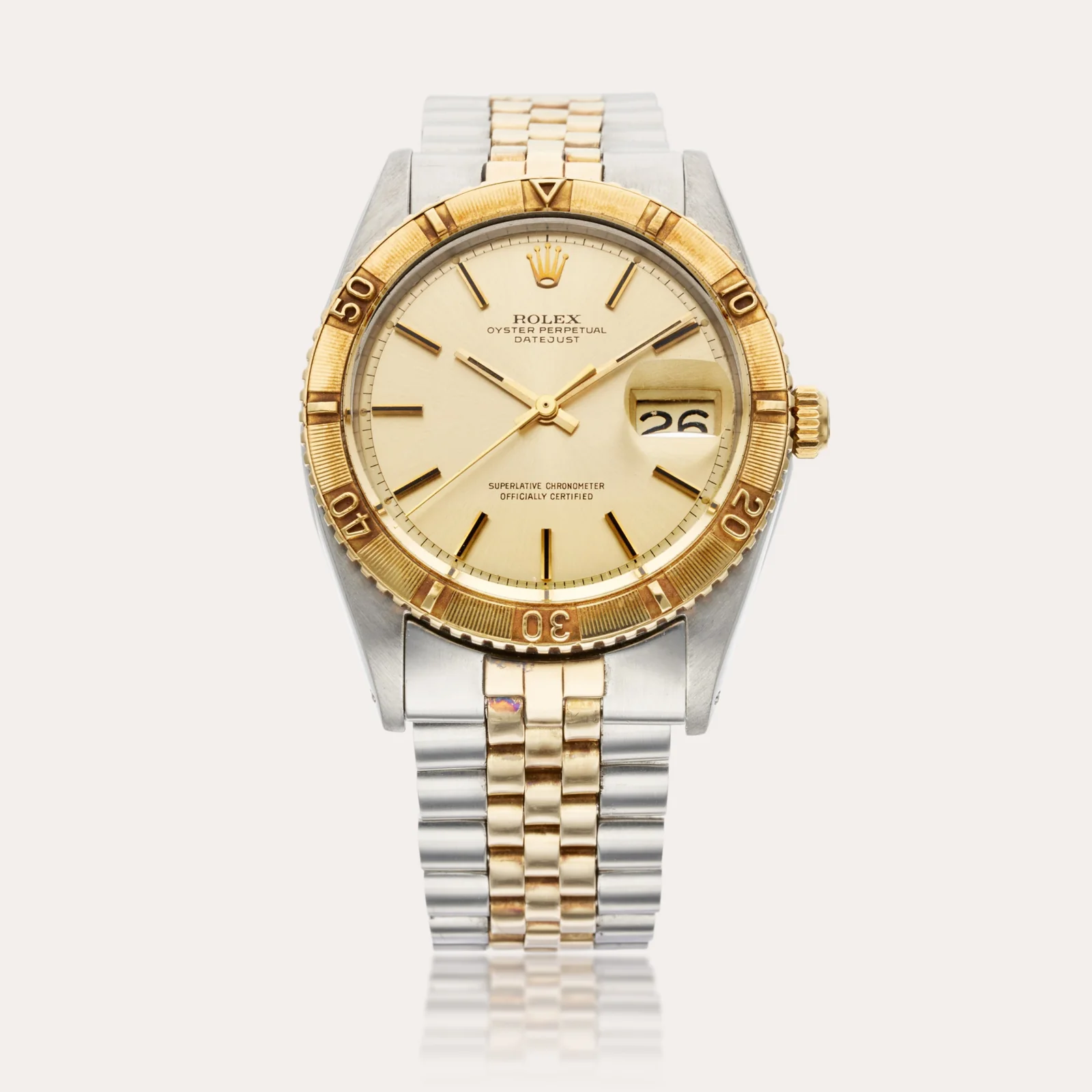 Sotheby's, circa 1971, case 2,754,615
-
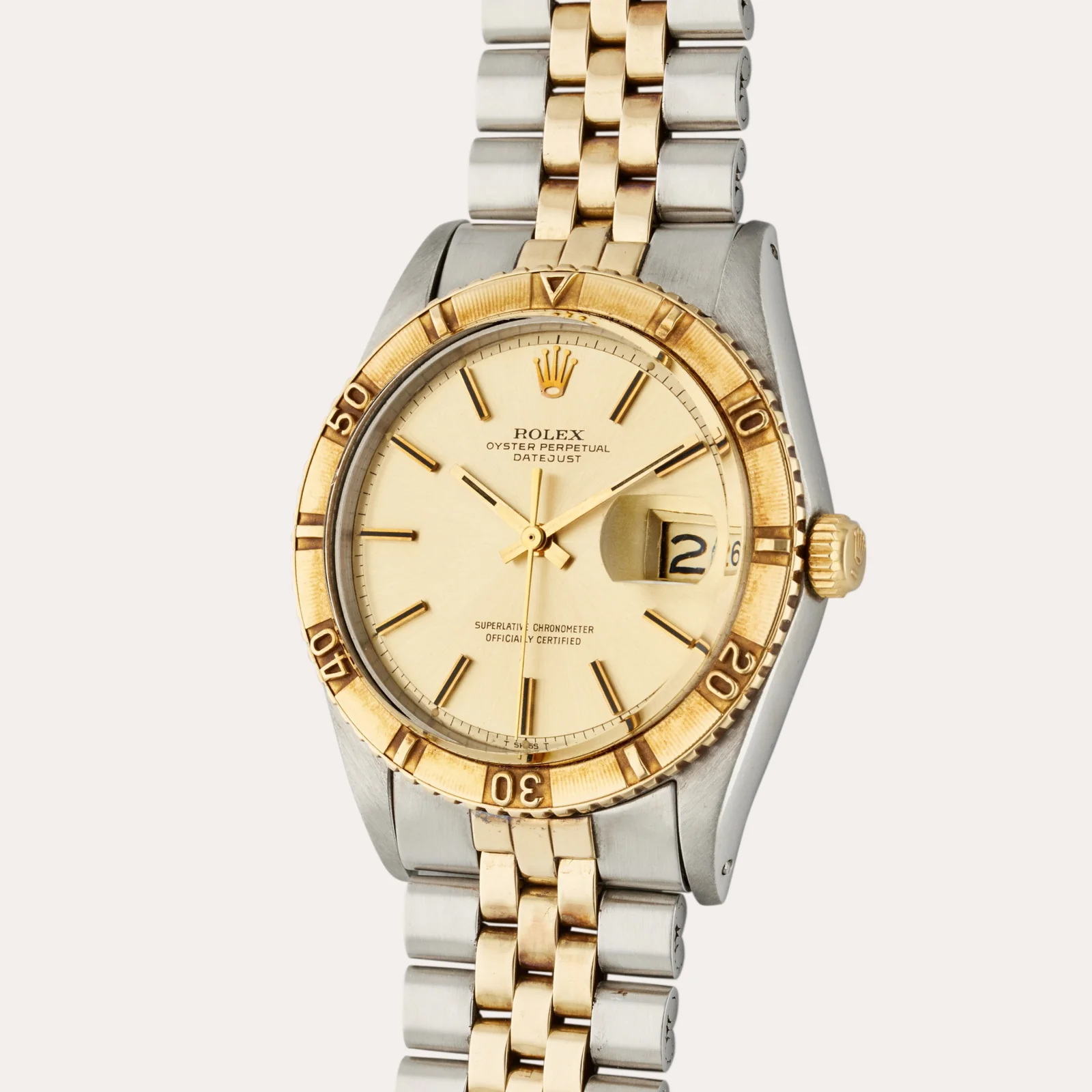 Dial and date magnifier
-
Case, crown, and bezel profile
-
Side profile of the case and bezel
-
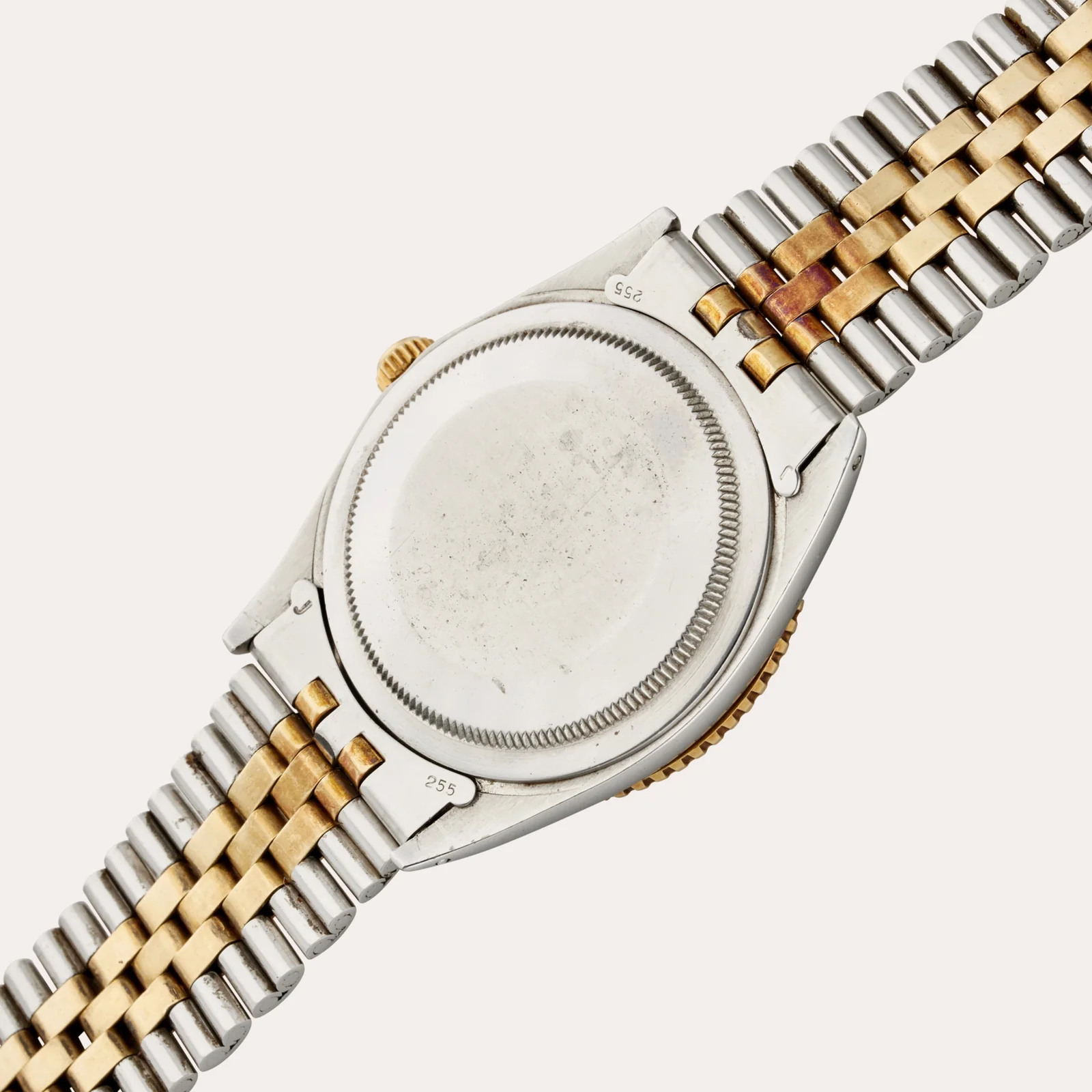 Caseback, bracelet, and end link
Sources
- "Antiquorum, The Mondani Collection, Geneva, 14 May 2006, lot 76 — ref. 1625", Antiquorum, 2006-05-14
- "Phillips, Hong Kong Watch Auction XVI, lot 1003 — ref. 1625", Phillips, 2023
- "Sotheby's, Fine Watches 2024 — Datejust Turn-O-Graph ref. 1625", Sotheby's, 2024
- "Sotheby's, Important Watches 2020 — Thunderbird Datejust ref. 1625", Sotheby's, 2020
- "Antiquorum, Geneva 2023, lot 185 — ref. 1625, case 538,990", Antiquorum, 2023
- "Antiquorum, Geneva 2023, lot 397 — ref. 1625 in 18k yellow gold", Antiquorum, 2023
- "Antiquorum, Geneva 2024, lot 285 — ref. 1625, grey linen dial", Antiquorum, 2024
- "Christie's Hong Kong, lot 5804918 — ref. 1625", Christie's, 2014
- Michael Stockton, "The Rolex 1625 Turn-O-Graph — Going Under the Radar", Fratello, 2018-07-26
- EmmyWatch, "Cal. 1565 movement-parts compilation", EmmyWatch
- "Calibre 1565 parts catalogue scan (hosted by WatchGuy)", Rolex
- "Cal. 1575 parts catalogue", Rolex
- "Bring a Loupe: A 1970 Rolex Turn-O-Graph Ref. 1625", Hodinkee, 2019
- "Rolex Datejust Reference Guide", Swiss Watch Club
- "Rolex Datejust ref. 1625", Amsterdam Watch Company
- "Is my 1625 a Turnograph or a Thunderbird?", The Rolex Forums, 2017
- "Cool Rolex of the Day #2478: 1625 Datejust Turn-O-Graph with “Double Swiss” dial", Reddit, r/rolex, 2024