
Rolex Yacht-Master 16628
Yacht-Master → 16628

Rolex introduced the Yacht-Master in 1992 with the 40 mm yellow-gold ref. 16628. It uses calibre 3135 and a raised, graduated bezel that turns to time an interval. Rolex's 2011 U.S. catalogue lists a synthetic sapphire crystal, a 31-jewel chronometer movement and Oysterlock bracelet 78768. It also records mother-of-pearl dial options, including versions set with diamonds and colored stones.
Core facts
| detail | value |
|---|---|
| reference | 16628 |
| family | Yacht-Master |
| introduction | 1992, according to Rolex |
| case | 40 mm, 18 ct yellow gold |
| movement | automatic date, calibre 3135, 31 jewels |
| crystal | synthetic sapphire |
| water resistance | 100 m, as reported by Fratello quoting Mondani’s 100 Years of Rolex |
| bezel | graduated 60-minute bezel; Rolex describes the Yacht-Master bezel as bidirectional |
| bracelet | Oysterlock 78768 listed by Rolex in 2011 |
| production end | unconfirmed |
Where it sits in the line
Ref. 16628 was the first Yacht-Master. It introduced the line in solid yellow gold; Fratello's history places the smaller gold refs. 68628 (35 mm) and 69628 (29 mm) in 1994. They carry separate references and smaller cases. Rolex's May 2011 U.S. catalogue still lists the 16628 among its 40 mm Yacht-Masters.
Production outline
Rolex dates the model's introduction to 1992. Its 2011 U.S. list includes ref. 16628. The June 2012 U.S. model table names 16622, 116622, 16623 and smaller models, and omits the 16628. The same 2012 list includes bracelet 78768 in its bracelet table, without identifying whether it was for service or current production. Rolex’s 2011 catalogue is the latest model list here to include the 16628; its production and delivery end dates remain unconfirmed.
Auction catalogues sometimes estimate individual watches earlier than Rolex's launch date. Sotheby's gives circa 1991 for case X705411, and Christie's gives circa 1990 for another example. Both lot estimates predate Rolex's 1992 introduction date; the auction records do not explain the discrepancy.
Movement notes
Ref. 16628 uses calibre 3135, the automatic date movement also found in several contemporary Rolex sports watches. Robert-Jan Broer’s Fratello history, quoting Mondani’s 100 Years of Rolex, identifies Cal. 3135 in the 16628; the 2011 Rolex list gives a 31-jewel chronometer movement but does not name the caliber. Auction catalogues for individual 16628 watches also identify calibre 3135. The serial and movement numbers identify those listed watches; a reference-wide movement chronology remains open.
Dial map
The records show white, blue and mother-of-pearl dials. Rolex's 2011 list names mother-of-pearl, diamond and sapphire-set, and diamond and ruby-set options. The base dial color is unspecified in that entry. Auction catalogues document a white dial on Antiquorum case X520495, estimated circa 1992; blue dials on Dorotheum case S663708, circa 1993, and Sotheby's case P'398'225, circa 2000; and mother-of-pearl on Christie's circa-2003 example. These dates belong to the catalogued watches.
The early Antiquorum example has smaller luminous triangles at the quarter hours. Antiquorum says later examples dropped them, without giving a changeover year. The included photographs show white and blue dials. Mother-of-pearl and gem-set variants still need suitable images.
-
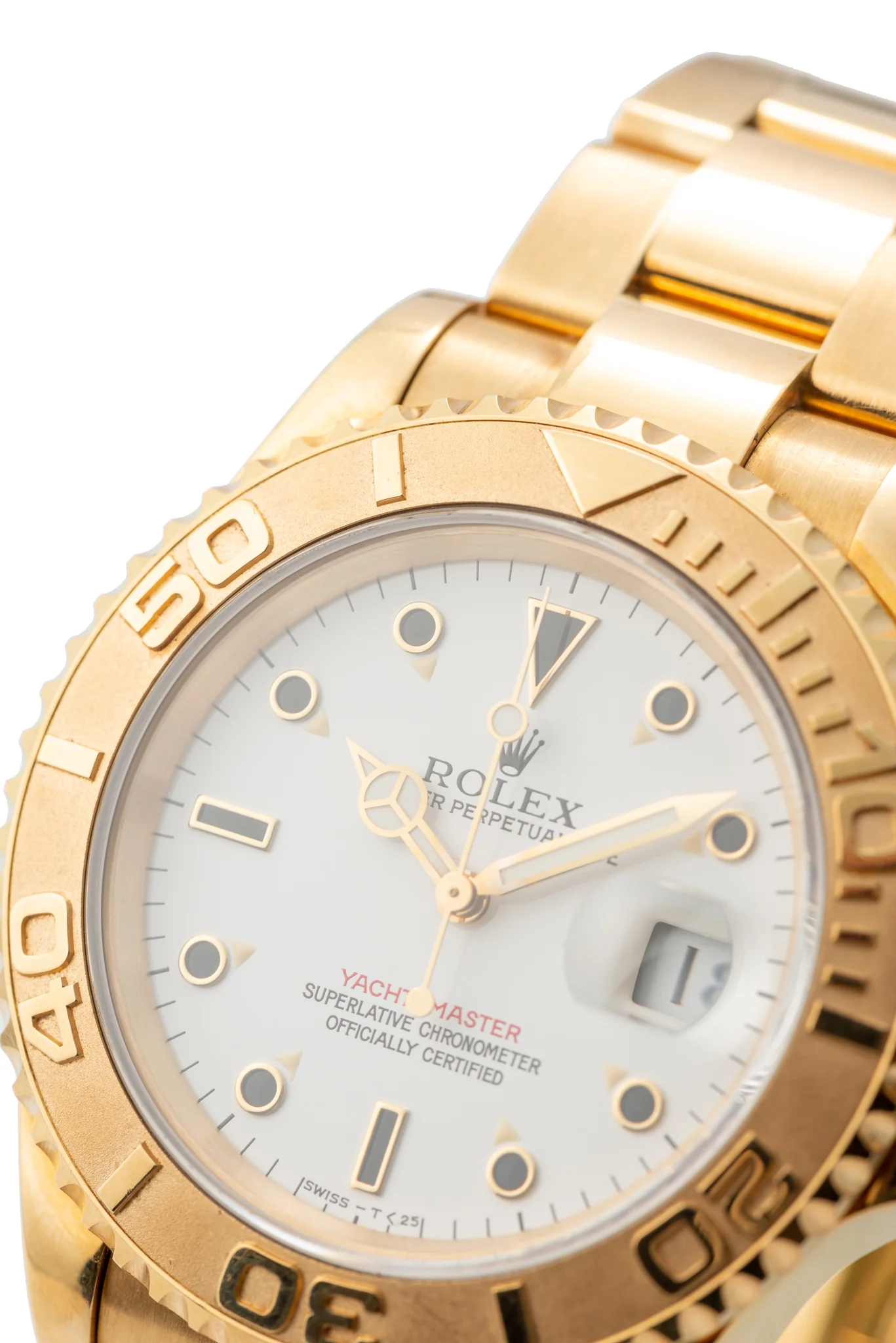 White dial and graduated bezel on case X520495. Photo: Antiquorum, Geneva, 2022, lot 168.
-
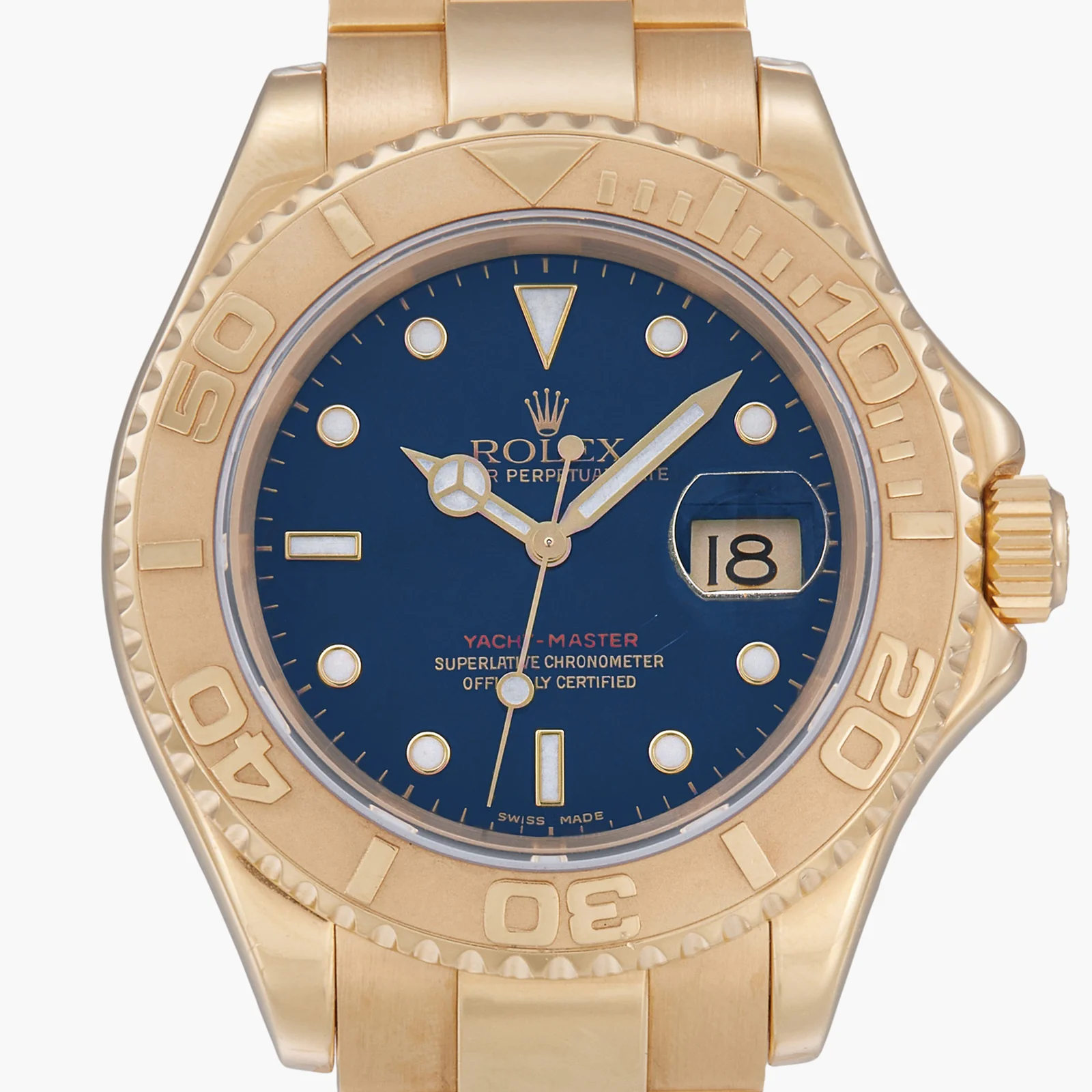 Blue dial on case P'398'225, catalogued circa 2000. Photo: Sotheby's, 2026, lot 349.


Case, bezel, crystal, and crown notes
The listed case is 40 mm across and made in 18 ct yellow gold. Rolex's 2011 list specifies synthetic sapphire. Christie's lists a 42 mm diameter for case T690934. Rolex and the other catalogues list 40 mm; keep 42 mm attached to that lot.
The bezel carries raised minute graduations. Rolex's current Yacht-Master description says it turns in both directions; Christie's describes a 16628 example with a 60-minute revolving bezel and Triplock crown. Christie’s 1999 lot describes a 60-minute revolving bezel and Triplock crown.
Antiquorum describes case X520495 as having a first-generation Submariner-shaped case. The label applies to that circa-1992 watch; the catalogue gives no changeover year.
Bracelets, end links, clasps, and packaging notes
Rolex's May 2011 U.S. catalogue pairs the 16628 with yellow-gold Oysterlock bracelet 78768. The June 2012 bracelet table lists it as 20 mm, with 13 links, but does not say whether the entry is for service or new watches. The two catalogues identify bracelet 78768 but give no end-link number. Auction records describe yellow-gold Oyster bracelets with Fliplock or folding clasps on individual watches; their chronology is unresolved.
Boxes, papers and booklets appear with individual auction lots. Those contents belong to the individual sale lots; a standard 16628 package is undocumented.
Special branches
Christie’s 2014 lot calls a blue-dial watch ref. 16628B and its bracelet 78768B. It attributes larger spring-bar holes and heavier bars to the suffix. The suffix’s factory status and chronology remain unresolved; 16628B is treated here as an auction-catalogue designation.
Historical market and auction record
The sale records document particular serials and configurations. Sotheby's records case X705411 with a circa-1991 estimate; Antiquorum records X520495 as circa 1992; Dorotheum dates S663708 circa 1993; Antiquorum dates T905898 circa 1996–97; Christie's describes U864132 as circa 1999 and Y172868 as circa 2003; Sotheby's dates P'398'225 circa 2000. The earlier estimates conflict with Rolex's 1992 launch account and remain attached to the relevant lots.

Gallery
-
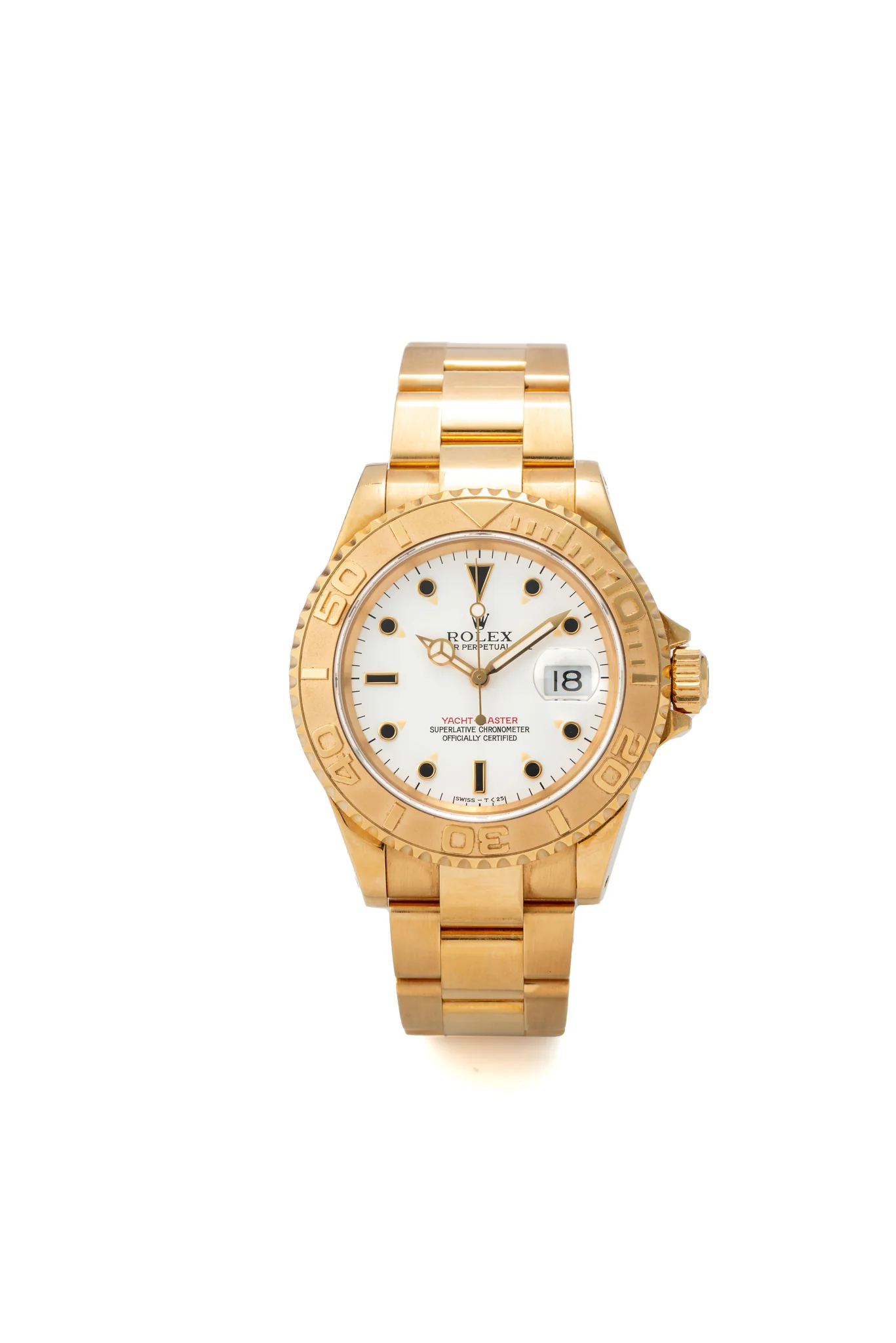 Case X520495, catalogued circa 1992. Photo: Antiquorum, Geneva, 2022, lot 168.
-
Dial detail of case X520495. Photo: Antiquorum, Geneva, 2022, lot 168.
-
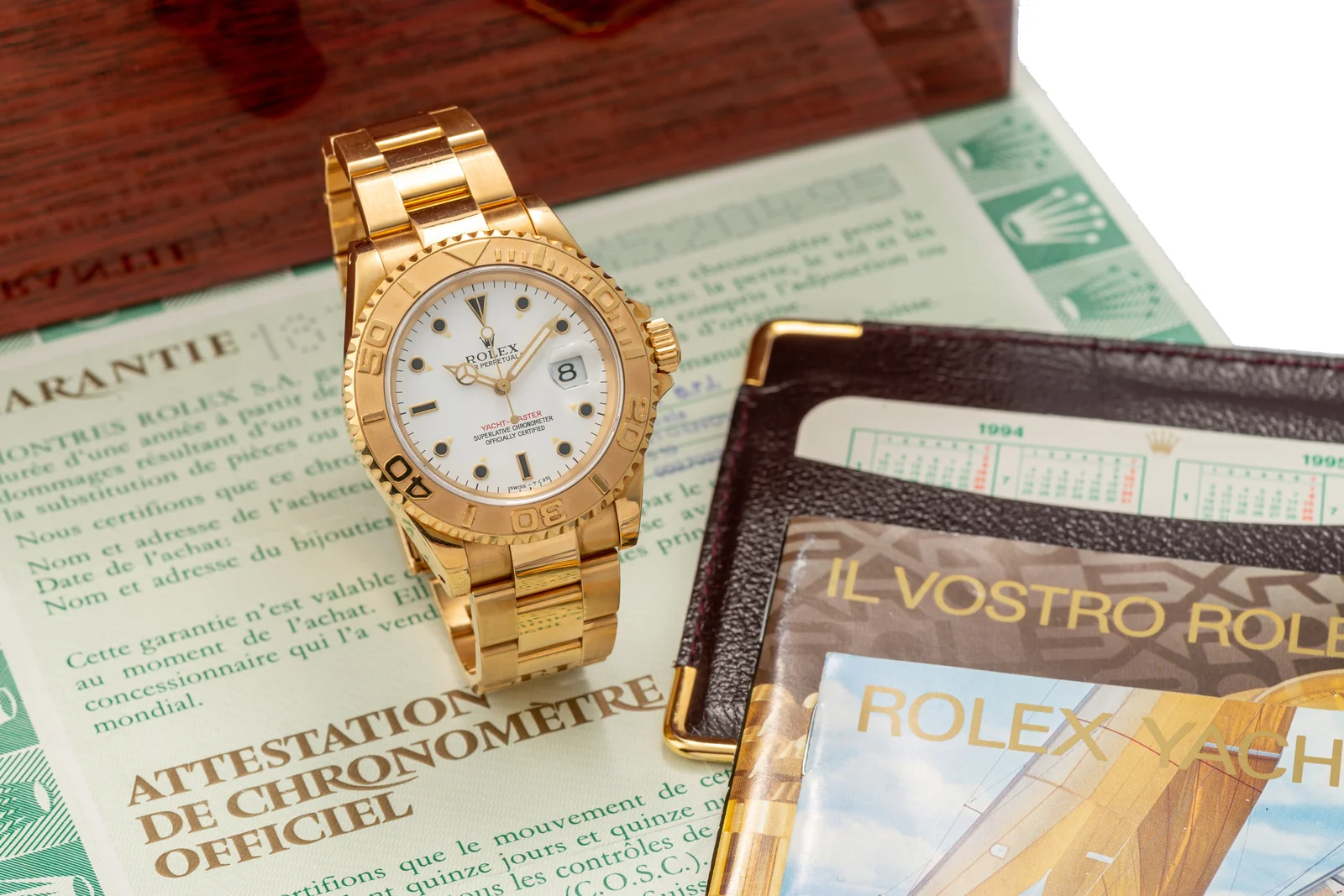 Case X520495 with the box and papers shown in the lot. Photo: Antiquorum, Geneva, 2022, lot 168.
-
Case P'398'225, catalogued circa 2000. Photo: Sotheby's, 2026, lot 349.
Sources
- Rolex, "A collection shaped by innovation", Rolex
- Rolex, "Oyster Watches price list, effective 10 May 2011", Rolex, 2011-05-10
- Rolex, "Rolex U.S.A. price list, effective June 1, 2012 — Yacht-Master models", Rolex Watch U.S.A., Inc., 2012-06
- Robert-Jan Broer, "Some Rolex Yacht-Master History", Fratello, 2009-03-18
- Dorotheum, "Wrist and Pocket Watches, lot 456: Rolex ref. 16628", Dorotheum, 2021-12-03
- Christie's, "Rolex Yacht-Master ref. 16628, lot 5623749", Christie's
- Antiquorum, "Rolex ref. 16628 Yacht-Master, lot 168", Antiquorum, 2022-05-07
- Sotheby's, "Fine Watches, lot 25: Rolex ref. 16628", Sotheby's
- Sotheby's, "Fine Watches, lot 349: Rolex ref. 16628", Sotheby's
- Christie's, "Rolex ref. 16628 with mother-of-pearl dial, lot 4970192", Christie's
- Christie's, "Rolex ref. 16628, lot 4713135", Christie's
- Christie's, "Rolex ref. 16628, lot 5091799", Christie's
- Antiquorum, "Rolex ref. 16628 with blue dial, lot 109", Antiquorum, 2021-06-26
- Christie's, "Watches Online, lot 6200120: Rolex ref. 16628B", Christie's
- Rolex, "Yacht-Master bezel features", Rolex