
Rolex Datejust Oysterquartz 17000
Datejust 36 → 17000

Reference 17000 is the all-steel, smooth-bezel Datejust in Rolex’s Oysterquartz line. The 1977 customer catalogue lists an integrated steel bracelet, sapphire crystal, 50 m water resistance and quick date change; exact-reference auction catalogues identify the movement as Cal. 5035. Auction records document blue, black, silver and white Roman dials.
Core facts
| Reference | Model | Case | Movement | Dates documented |
|---|---|---|---|---|
| 17000 | Datejust Oysterquartz | Stainless steel, smooth bezel, about 36 mm | Cal. 5035, quartz, 11 jewels | Catalogue examples c.1977–c.2001; factory endpoints unknown |
Published dates chart individual examples from the launch year through the turn of the century. Phillips catalogues one example circa 2001 with a guarantee dated 2003.
Where it sits in the line
The 17000 is the all-steel, smooth-bezel Oysterquartz Datejust. The related 17013 combines steel and yellow gold with a fluted bezel; 17014 pairs steel with a white-gold fluted bezel. The 1977 Rolex customer catalogue shows the 17000 and two-tone 17013 alongside a gold Oysterquartz Day-Date. Oysterinfo reports that the 17014 joined later.
Production outline
The 1977 Rolex catalogue lists the 17000. Sotheby’s dates a black-dial watch circa 1977 and a blue three-line example circa 1978; Antiquorum dates another steel watch circa 1978. Dr. Crott dates a silver-dial example circa 1979, Antiquorum a white Roman example circa 1982, and Christie’s a silver dial circa 1983. Gardiner Houlgate records a blue baton dial circa 1989, while Phillips dates a K-serial example circa 2001. Sotheby’s gives case 5,365,653 to its 1977 black dial and 5,362,683 to the circa-1978 blue dial. The lower case number carries the later estimate; treat these as two lot dates, not serial-year anchors.
Phillips calls its circa-2001 example one of the last batches and records a guarantee dated 2003. Antiquorum’s 2012 catalogue dates production’s end to around 1995; its description identifies the watch as ref. 17000 while the title says 17000B. Oysterinfo says Rolex removed the steel version from its catalogue in 2002 and suggests production may have continued that year. The latest cited watch is Phillips’s circa-2001 example; Oysterinfo leaves open whether production continued into 2002. The final production year remains unresolved.
Movement notes
The 17000 uses Rolex Cal. 5035, an in-house quartz movement with 11 jewels. Rolex’s Technical Information No. 13 identifies a 32,768 Hz quartz resonator and a Rolex step-by-step motor. The 5035 drives central seconds and a date display; the 1977 catalogue advertises quick date change. Sotheby’s circa-1977 and circa-1978 examples lack the chronometer wording; Auktionen Dr. Crott’s circa-1979 silver-dial example carries it. Oysterquartz.watch places the change around 1979, while Oysterinfo gives 1981. The published records leave the serial cutoff unresolved. Collectors call the early non-COSC and later COSC-marked dials “Mark I” and “Mark II”; these are collector labels. See Movements for the Cal. 5035 drive.
Dial map
Oysterquartz.watch identifies black, blue and silver as early non-COSC dial colors. Sotheby’s illustrates black and blue three-line examples from circa 1977–78. Dr. Crott’s circa-1979 silver dial carries chronometer wording. Sotheby’s uses “Buckley” for its white Roman 17000 listing dated 1981; Antiquorum describes a similar dial as white Roman circa 1982. Christie’s records a silver dial circa 1983, and Gardiner Houlgate a blue baton dial circa 1989. “Buckley” is collector and sales terminology, not a documented Rolex variant name.
-
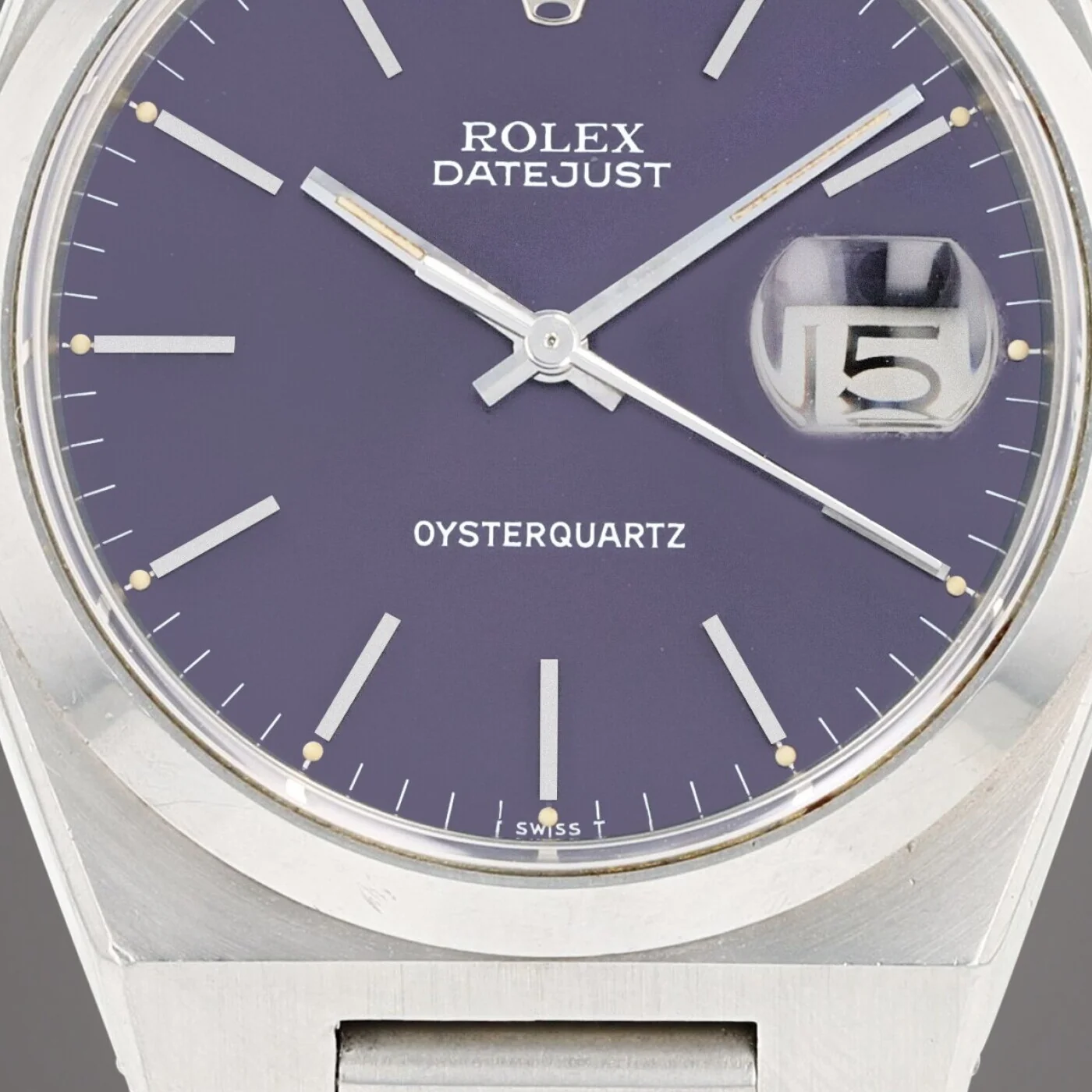 Blue, early non-COSC dial. Sotheby’s, lot 138 (2022).
-
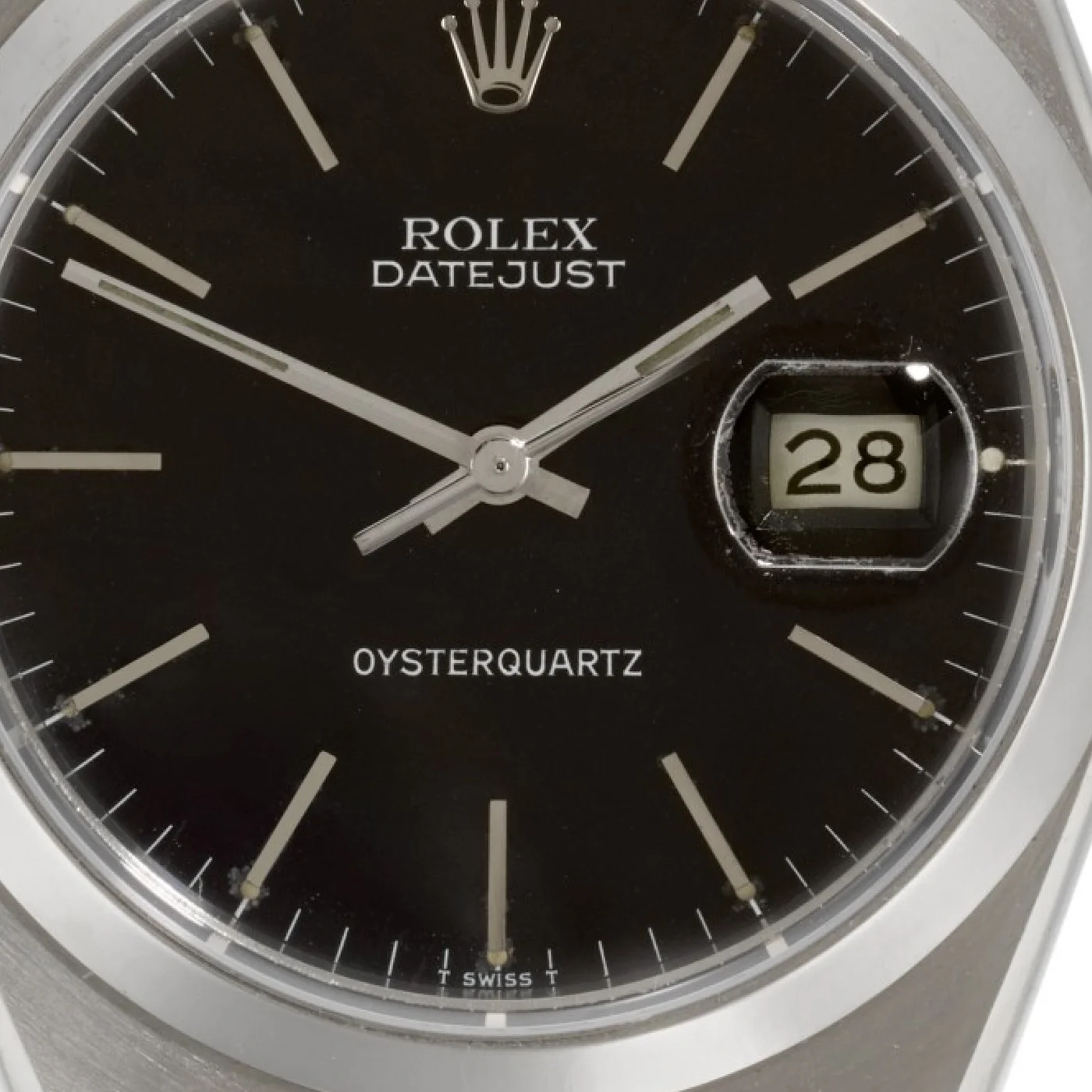 Black, early non-COSC dial. Sotheby’s, lot 60 (2019).
-
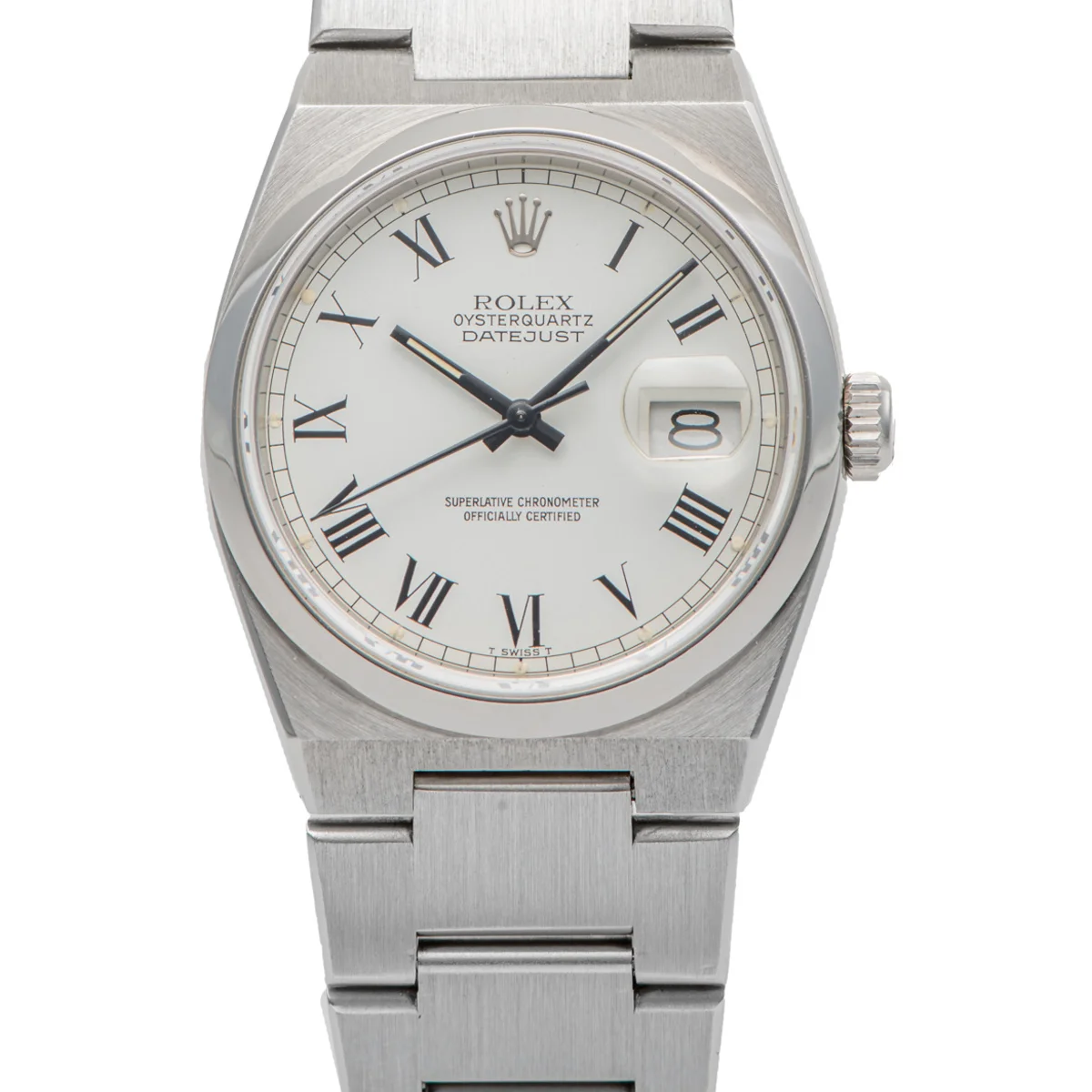 White Roman dial. Antiquorum, lot 491 (2020).
-
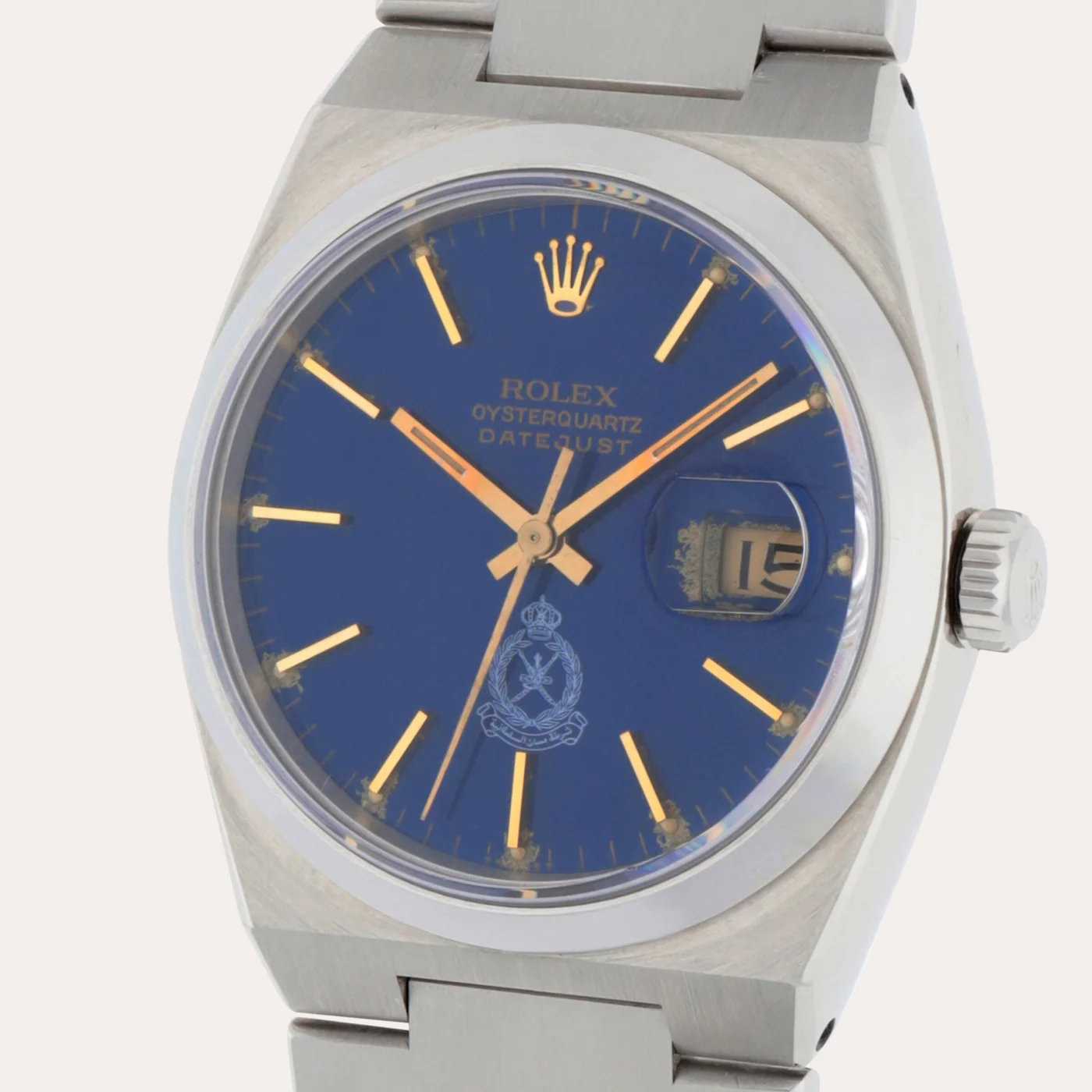 Blue dial with Royal Oman Police crest. Sotheby’s, lot 326 (2025).
-
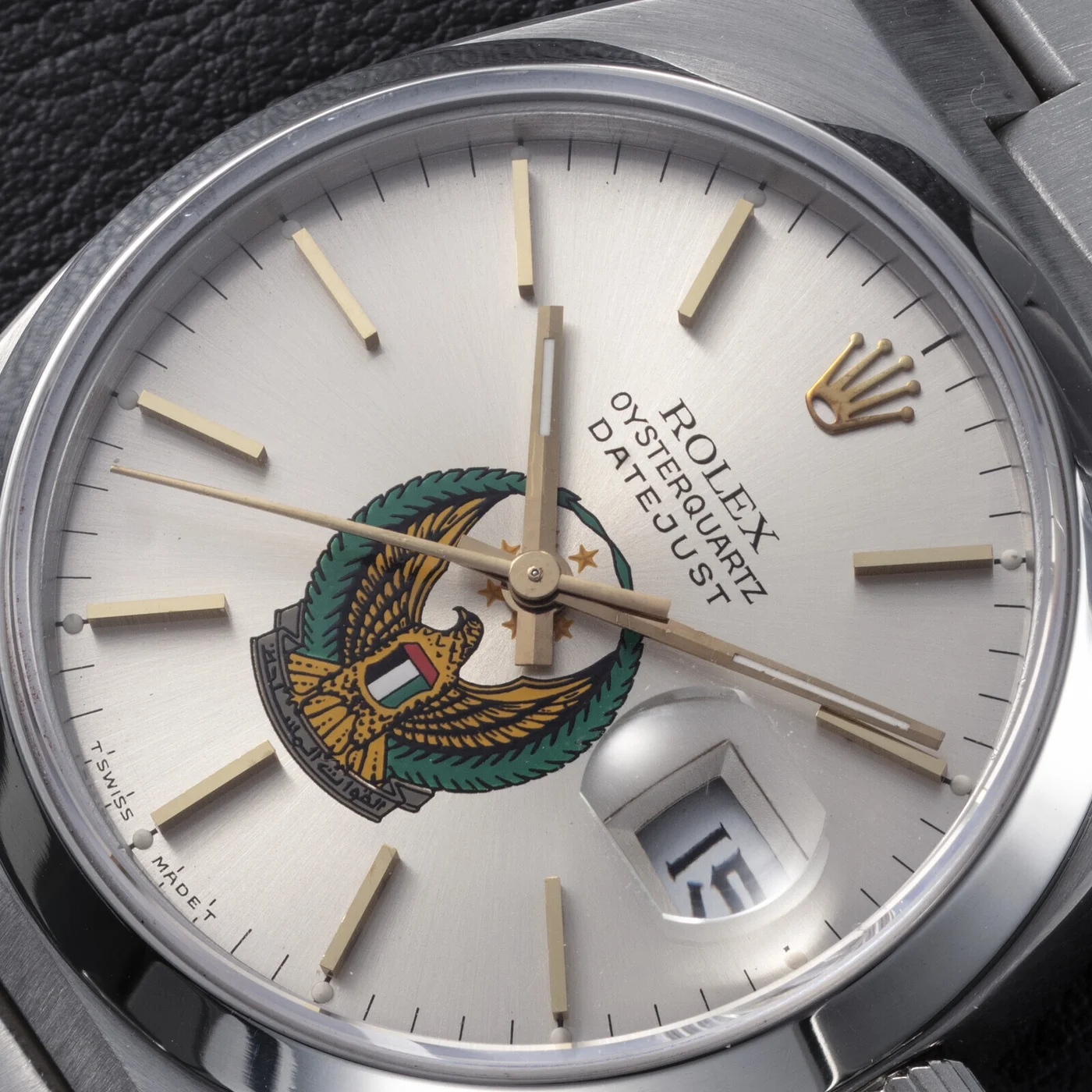 Silver dial with UAE Armed Forces crest. Christie’s, lot 96 (2022).


Case, bezel, crystal, and crown notes
The case is stainless steel, with the angular Oysterquartz profile and a smooth bezel. The 1977 catalogue gives a 50 m water-resistance rating. Auction catalogues generally give a 36 mm diameter; Sotheby’s records one example at 36.5 mm. Treat 36 mm as the nominal published size. Rolex’s 1977 catalogue and Fratello’s 1988 example specify sapphire. Antiquorum describes plastic on one circa-1979 lot. The two descriptions conflict; the crystal fitted to a surviving watch has to be judged on that example.

Bracelets, end links, clasps, and packaging notes
The 17000 is shown with an integrated steel Oysterquartz bracelet. Auction catalogues record bracelets stamped 17000 or 17000B, including a 17000B bracelet on Phillips’s circa-2001 lot. Oysterquartz.watch reports both pin and screw construction and says the 17000B stamp alone does not distinguish them. The stamp identifies the bracelet. Separate provenance or factory records are needed to establish original delivery.
Phillips records a DT3 clasp and a guarantee dated 2003 with its circa-2001 example.

Everest advertising and attribution
Rolex’s period advertising connected the Oysterquartz with Reinhold Messner and Peter Habeler’s 1978 Everest ascent. Christie’s later catalogue attributes ref. 17000 to Messner’s watch but publishes no case number or provenance chain linking it to a surviving example.
Government and retailer-signed dials
Auction catalogues document individual 17000 watches with government insignia: Sotheby’s describes a circa-1981 blue dial with the Royal Oman Police crest, and Christie’s a circa-1988 silver dial with the UAE Armed Forces crest. Christie’s says its example was made to special order. Sotheby’s records a separate 17000 retailed by Tiffany & Co.; that lot has a silver dial and a personal caseback inscription. Oysterquartz.watch illustrates another dial it identifies as Tiffany-signed. The sources document these individual watches; the number of commissions and their delivery terms remain open.
Auction record
| Sale | Catalogue date | Recorded details |
|---|---|---|
| Sotheby’s, Watches Online 8, lot 60 | c.1977 | Black early dial; case and movement numbers; Cal. 5035 |
| Sotheby’s, Fine Watches, lot 138 | c.1978 | Blue early dial; case no. 5’362’683; Cal. 5035 |
| Sotheby’s, Mellon Jewelry, lot 147 | date not stated | Silver dial; ref. 17000 retailed by Tiffany & Co.; personal caseback inscription |
| Antiquorum Geneva, lot 491 | c.1982 | White Roman dial; case no. 7’259’820; bracelet stamped 17000B |
| Antiquorum Geneva, lot 307 | c.1978 | Case no. 5’801’035; Cal. 5035, 11 jewels |
| Christie’s, lot 6316340 | c.1983 | Silver dial; case no. 7’559’184; Cal. 5035 |
| Auktionen Dr. Crott, 101st Auction, lot 319 | c.1979 | Silver dial with chronometer wording; case no. 6’409’992; Cal. 5035; 17000B bracelet and P9 clasp |
| Gardiner Houlgate, lot 18 | c.1989 | Blue baton dial; L-prefix case number; condition notes include crystal-edge chips and uneven lume plots |
| Phillips Hong Kong, lot 8087 | c.2001 | Catalogue title says 17000A; K439’310 case; bracelet stamped 17000B; guarantee dated 2003 |
| Sotheby’s, Important Watches II, lot 326 | c.1981 | Blue dial with Royal Oman Police crest; case no. 6’468’683 |
| Christie’s Dubai, lot 96 | c.1988 | Silver dial with UAE Armed Forces crest; Cal. 5035 |
| Antiquorum Geneva, lot 200 | c.1979 | Body says ref. 17000 despite “17000B” title; describes plastic crystal and gives a circa-1995 end date that conflicts with Phillips’s later example |
For serial-number context, see Serial numbers.
Gallery
-
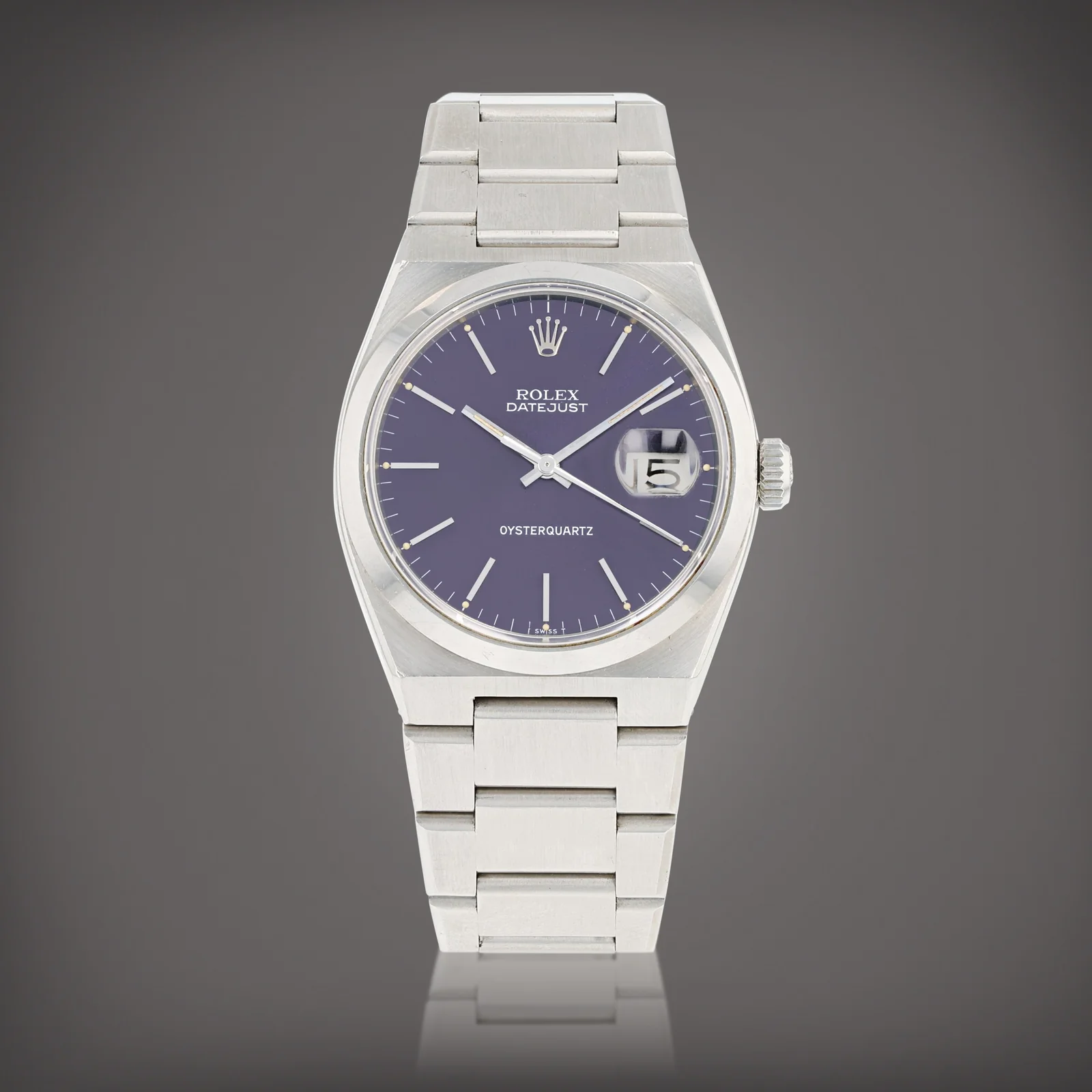 Whole watch, circa 1978. Sotheby's, lot 138 (2022).
-
Blue early dial. Sotheby's, lot 138 (2022).
-
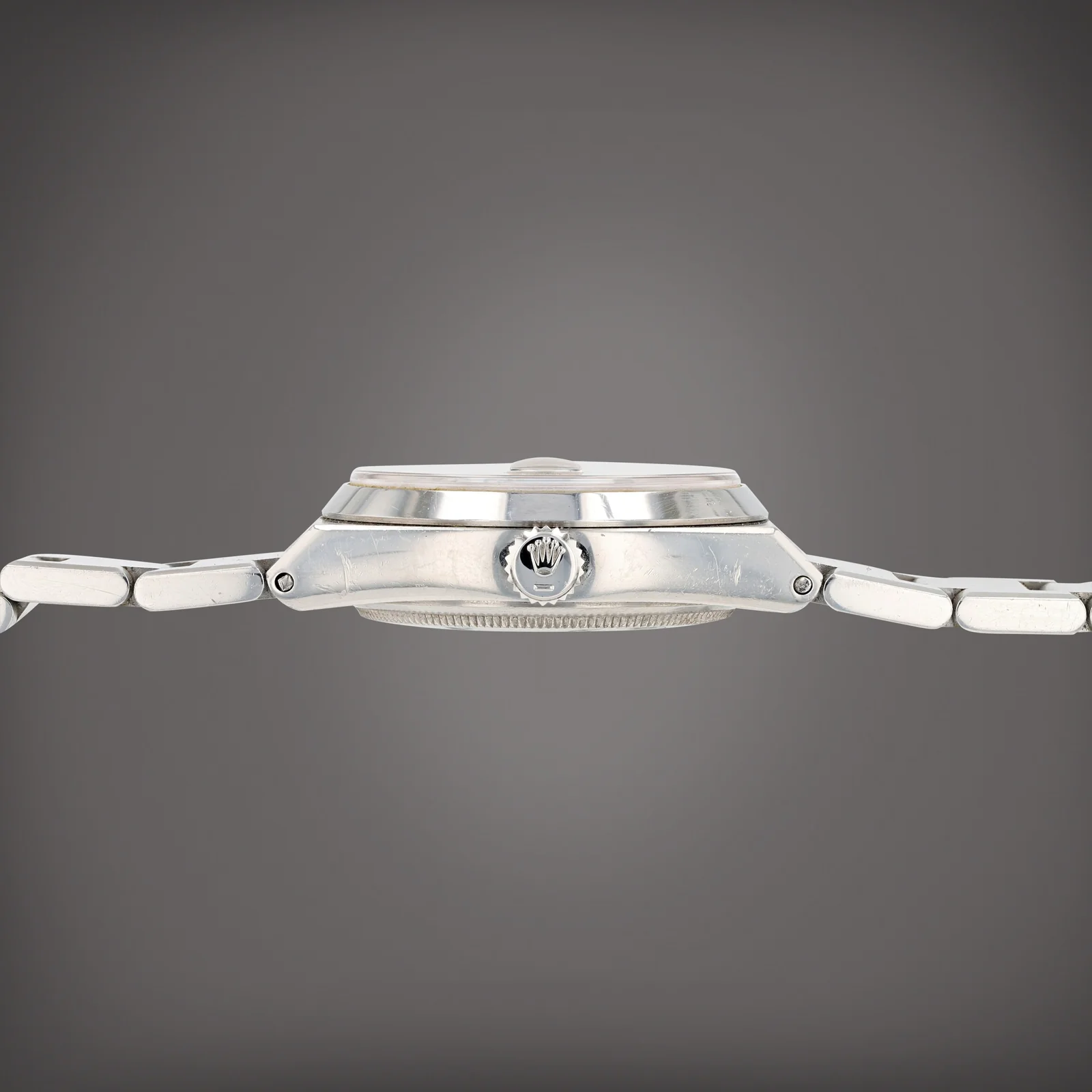 Side profile showing case and bezel. Sotheby's, lot 138 (2022).
-
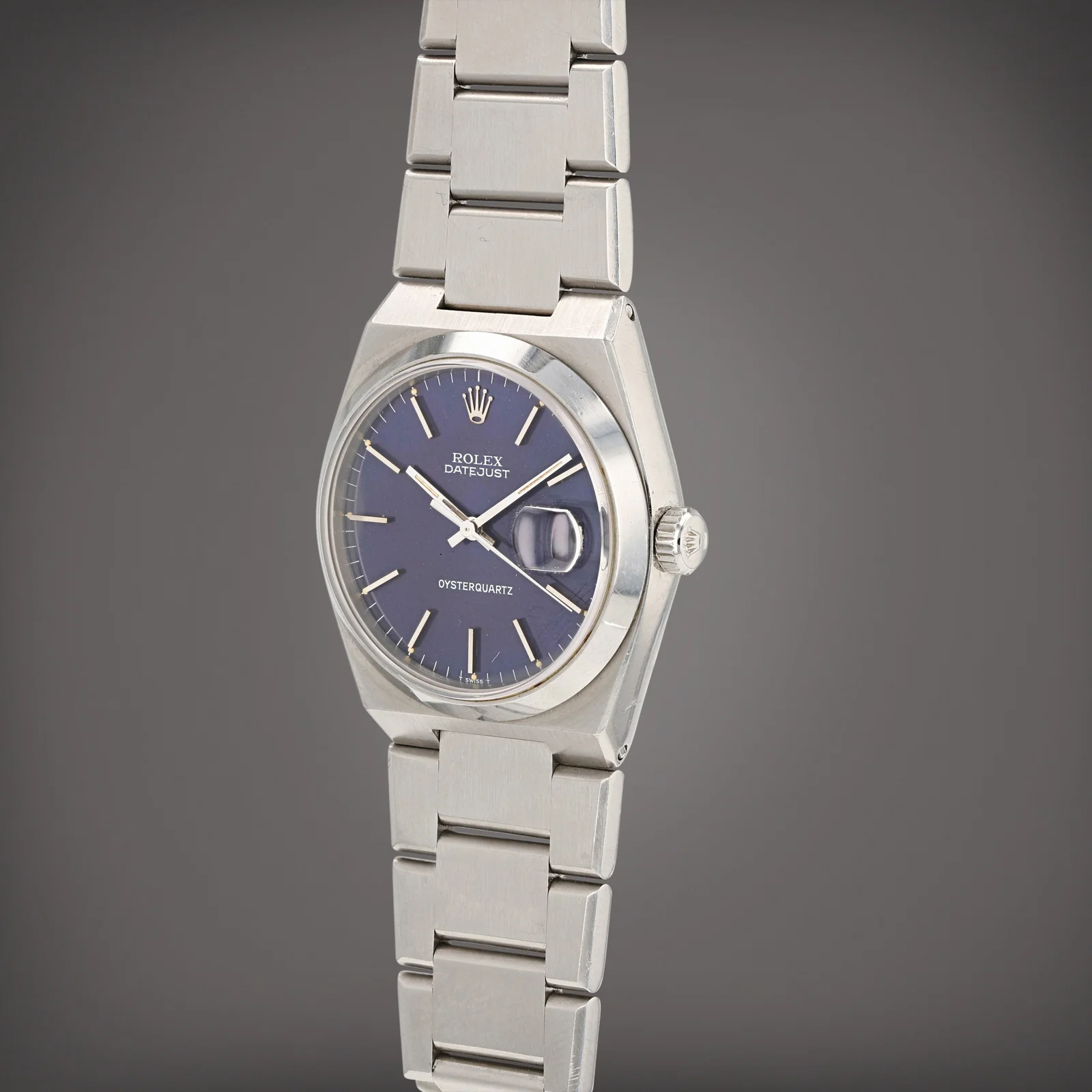 Angled view with integrated bracelet. Sotheby's, lot 138 (2022).
Sources
- "Rolex Oysterquartz customer catalogue, 1977 (scan)", Rolex; scan hosted by Oysterquartz.watch
- "Rolex Technical Information, calibers 5035 and 5055", Rolex
- "Sotheby's, Mellon Jewelry, lot 147, ref. 17000 retailed by Tiffany & Co.", Sotheby's, 2014
- "Sotheby's, Important Watches II, lot 326, ref. 17000 made for the Royal Oman Police", Sotheby's, 2025
- "Christie’s Dubai, Watches Online: The Dubai Edit, lot 96, ref. 17000 with UAE Armed Forces crest", Christie’s, 2022
- "Sotheby's, Datejust Oysterquartz 'Buckley' dial, ref. 17000, 1981", Sotheby's
- "Oysterquartz.watch, reference 17000", Oysterquartz.watch
- "Oysterquartz.watch, Datejust evolution", Oysterquartz.watch
- "Rolex Oysterquartz: History, Models and Movements", Oysterinfo
- "Sotheby's Watches Online 8, lot 60, ref. 17000", Sotheby's
- "Sotheby's Fine Watches, lot 138, ref. 17000", Sotheby's
- "Antiquorum Geneva 2020, lot 491, ref. 17000", Antiquorum
- "Antiquorum Geneva 2023, lot 307, ref. 17000", Antiquorum
- "Christie's, lot 6316340, ref. 17000", Christie's
- "Phillips Hong Kong 2024, lot 8087, catalogue ref. 17000A", Phillips
- "Gardiner Houlgate 2023, lot 18, ref. 17000", Gardiner Houlgate
- "Ticking Along With The Rolex Datejust Oysterquartz 17000", Fratello
- "Antiquorum Geneva 2012, lot 200, case no. 6010469", Antiquorum
- "Auktionen Dr. Crott, 101st Auction, lot 319, ref. 17000", Auktionen Dr. Crott (Uhren-Muser archive), 2019-11-16