
Rolex Oyster Dato-Compax 6036
Pre-Daytona chronographs → 6036

Rolex used reference 6036 for a manual-wind triple-calendar chronograph with three chronograph registers. Auction records show steel, yellow-gold and rose-gold cases, with English, French or Spanish calendar discs. Most catalogues identify Valjoux 72C; one lists Valjoux 72. Published dates vary.
Core facts
| Field | Detail |
|---|---|
| Reference | 6036 |
| Type | Manual-wind triple-calendar chronograph |
| Family | Dato-Compax / Oyster chronograph line |
| Documented dates | Auction dates for individual examples run from circa 1950 to circa 1958; published production claims range from 1948 to the early 1960s |
| Documented case metals | Stainless steel, 18k yellow gold and 18k rose gold |
| Diameter | 36 mm in most reviewed lots; Christie’s lists one gold example at 34 mm and Sotheby’s one at 35 mm |
| Movement | Manual Valjoux 72C in most reviewed lots; Monaco Legend lists one ref. 6036 as Cal. 72; 17 jewels in several examples |
| Calendar | Day and month apertures at 12; central pointer date around the dial |
| Case | Screw-down Oyster back; Watchlover and Rolex Passion Report describe a one-piece upper case with a separate back; Antiquorum calls it two-part; Bonhams calls it three-piece |
| Documented dial languages | English, French and Spanish day/month discs |
Where it sits in the line
The 6036 is an Oyster Dato-Compax: a chronograph with day, month and pointer-date indications. Bonhams and Sotheby’s place it after refs. 4767 and 5036 and before 6236. Phillips treats the non-Oyster ref. 4768 as a separate branch. Collectors and auction houses use both “Dato-Compax” and “Jean-Claude Killy” for the wider family; Phillips notes that “Dato-Compax” was used in the Italian market.
The Killy story is less settled than the nickname. Bonhams says he was reportedly seen wearing a 6036. Bob’s Watches says no photograph of him wearing a Dato-Compax has surfaced, while Rolex Passion Report identifies the Explorer II 1655 as the watch shown in his skiing-era Rolex advertising. The nickname is well established; the claimed 6036 sighting remains a report, not a documented identification.
Production outline
Published production dates conflict. Sotheby’s gives 1948–1955. Phillips says the reference was introduced in 1951 and shows a circa-1955 example; Watchlover and Antiquorum’s 2022 catalogue give 1951–1955. Christie’s dates the launch to 1950 and the end to 1958 in its 2021 catalogue, then to the early 1960s in a 2023 lot essay. Antiquorum’s 2023 lot note also says 1958 to the early 1960s. These are catalogue and editorial dates; none cites a Rolex production ledger.
Catalogues date individual examples from circa 1950 to circa 1958. Cases 685524 and 685525 are dated around 1950; 847031, 847048, 847123 and 847210 around 1951–1952; 917851, 917876, 917889 and 917903 around 1952–1953; 943980 and 943994 around 1954–1955. Sotheby’s dates case 917831 to circa 1958, while other 917xxx examples are dated several years earlier. These are estimates for specific watches, not a case-number calendar. Christie’s describes case 685525 as part of a 12-piece 1950 series; that statement applies to the lot’s claimed series, not the total 6036 production.
Published counts also differ. Phillips reports 380 steel examples; Christie’s says 500 steel watches were made and 75 have been identified. Antiquorum gives 170 yellow-gold and 144 pink-gold examples, while Christie’s says 65 yellow-gold watches are publicly known. These figures mix estimated production with watches identified publicly; no cited factory register reconciles them.
Movement notes
Most auction descriptions identify the 6036 movement as Valjoux 72C; several list 17 jewels. Monaco Legend catalogues pink-gold case 847210 as Cal. 72, not 72C. Its image set shows the dial and case but no movement, so the catalogue label cannot be checked against an engraving. Antiquorum's 2024 movement photo of a steel 6036 shows “72C.” The Rolex Forums thread also calls 72C common in triple-date chronographs, but that is family-level collector evidence.
The Movements guide records 72C separately from Rolex’s Daytona calibers. The auction labels remain lot-specific; check the movement engraving before assigning a caliber to an individual watch.

Dial map
The dial has day and month apertures below 12, a central arrow-tipped date hand and three chronograph registers. English discs appear on gold cases 685525 and 917831; French discs on gold cases 685524 and 847123; Spanish discs on steel cases 917876 and 917903 and pink-gold case 847210. Christie’s calls the 917876 Spanish dial a likely service exchange; it describes the dial on case 917903 as original.
Phillips calls steel case 917851 an “Oyster Solo” and describes small bullet markers with luminous dots. Other catalogued examples show applied gold dagger or lozenge markers and recessed gold pyramids. Watchlover also notes the absent outer seconds scale and reversed date numerals 8 and 24. Christie’s describes closed 6 and 9 numerals on case 917876. These are documented dial treatments; the surviving descriptions do not establish a production sequence.
Sotheby’s identifies the dial on case 943980 as a later 6236 dial. On case 943994, it describes a period Rolex-only dial that was probably mounted later. Christie’s likewise says the Spanish-calendar dial on case 917876 was likely exchanged during service. These lots show later-dial examples that a collector may encounter; the auction houses do not attribute them as original 6036 variants.
Case, bezel, crystal, and crown
Most catalogues list a 36 mm diameter. Christie’s gives 34 mm for case 944072, and Sotheby’s gives 35 mm for case 917831. Watchlover and Rolex Passion Report describe a one-piece upper case with a separate screw-down back; Antiquorum calls the 6036 two-part. Christie’s calls the bezel and upper case monobloc, wording compatible with those descriptions. Bonhams instead calls it three-part. Watchlover and Rolex Passion Report distinguish the later 6236 by its separate bezel and three-part construction. Bonhams’ part count differs; inspect the individual case rather than using the count alone to identify a reference.
Auction descriptions and photographs show screw-down crowns, two chronograph pushers and calendar correctors in the case band. Sotheby’s describes a Twinlock crown on one steel example. That period construction does not establish a surviving watch’s present water resistance; Sotheby’s sale terms disclaim a current guarantee.
-
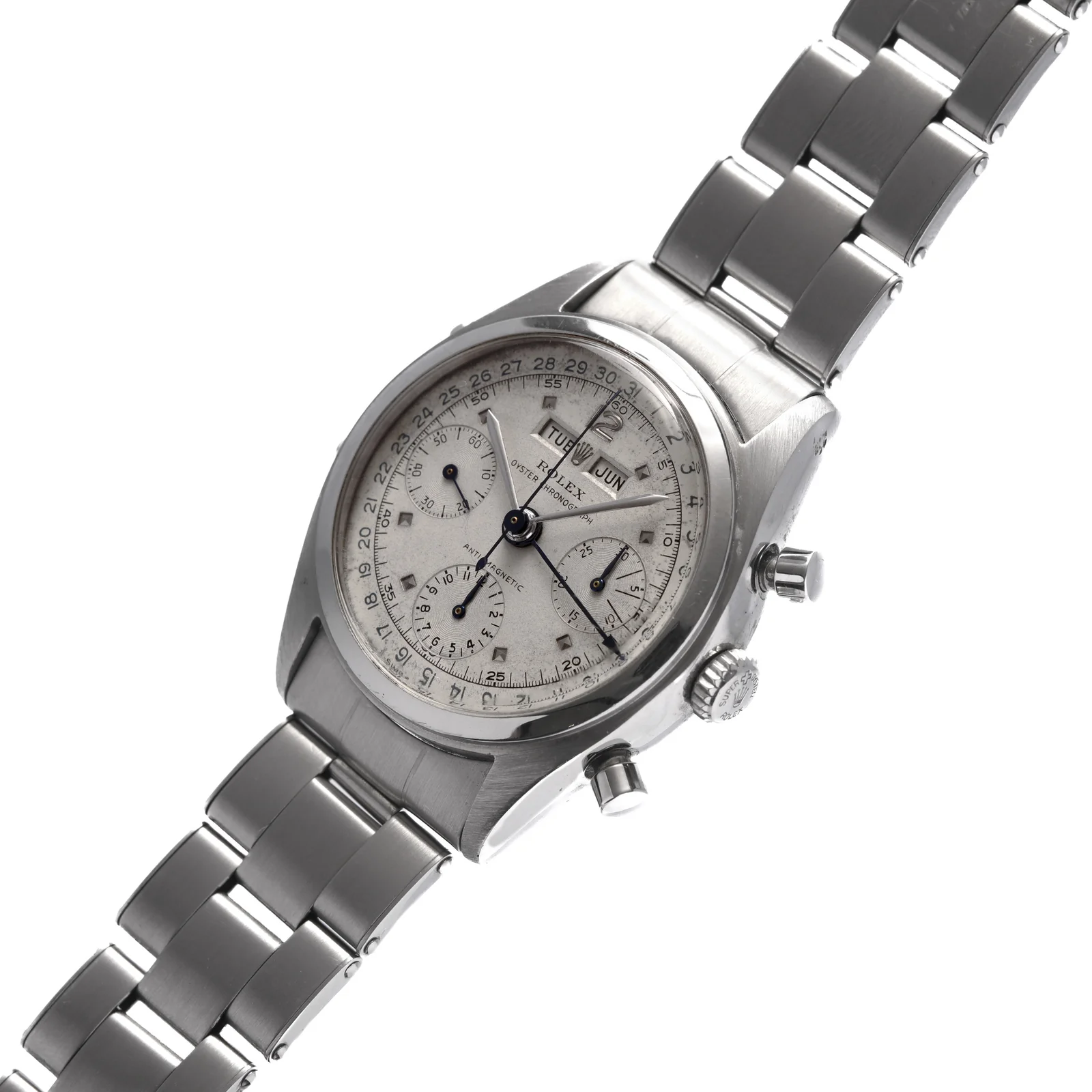 Angled case and crown view of the same Antiquorum example. Photo: Antiquorum.
-
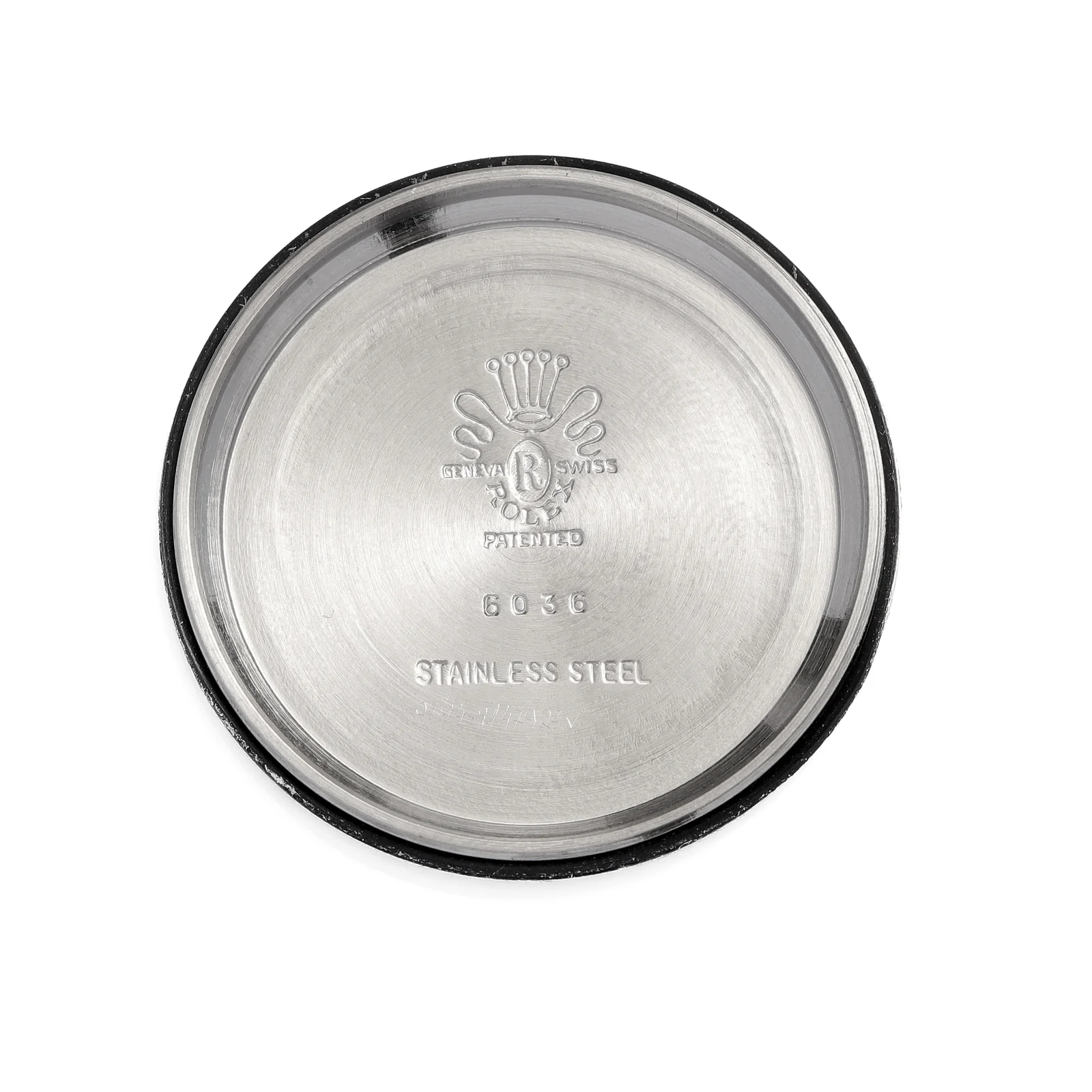 Inside caseback stamped 6036 and stainless steel. Photo: Antiquorum.


Bracelets, end links, clasps, and packaging
Catalogued examples appear on leather straps, expandable riveted Oyster bracelets and a gold Jubilee bracelet. Phillips records a steel Oyster Solo on leather; Antiquorum lists expandable bracelets with clasp stamps “49” and 1971; Uhren-Muser describes a rose-gold Jubilee bracelet stamped 4/54. Christie’s records a steel bracelet with clasp 453 and end links 57 on case 917903. These are lot-specific fitments; the catalogues do not establish original delivery. Some lots include a box or guarantee, which documents those individual watches rather than a standard 6036 package.
Special branches
Serpico y Laino signatures appear on a steel Antiquorum example and Monaco Legend’s pink-gold case 847210, which has Spanish calendar discs. The steel listing’s case number is partly unreadable. These two catalogues document the retailer-signed branch in both metals; they do not establish how frequently it was ordered.
Auction record
| Record | What the catalogue documents |
|---|---|
| Phillips Hong Kong Watch Auction XXII, lot 1083 | Steel case 917851, circa 1952, Cal. 72C/17 jewels, 36 mm, Oyster Solo dial; sold for HK$508,000. Phillips reports 380 steel examples, a catalogue estimate. Catalogue |
| Christie’s, case 917876 | Steel, circa 1953, Spanish calendar discs, 36 mm; Christie’s says the dial was probably exchanged during service. The lot included a guarantee and period box. Catalogue |
| Sotheby's, lot 1069 | Steel case 847031, circa 1952, white-grené dial, Cal. 72C/17 jewels, 36 mm. Catalogue |
| Antiquorum Geneva, lot 361 | Steel case 847048, circa 1951, Cal. 72C/17 jewels, 36 mm; the bracelet clasp is dated 1971. Catalogue |
| Christie’s, case 685525 | 18K gold, circa 1950, English calendar discs, 36 mm; Christie’s identifies it as part of a 12-piece 1950 series. Catalogue |
| Christie’s, case 847123 | 18K gold, circa 1951, French day/month discs, Cal. 72C/17 jewels, 36 mm. Catalogue |
| Christie’s, case 944072 | 18K gold, circa 1953, Cal. 72C/17 jewels; the catalogue lists a 34 mm diameter and describes a grained silver dial, lozenge markers and luminous material. Catalogue |
| Uhren-Muser, 105th Auction, lot 17 | Rose-gold case 113771, circa 1955, two-tone silvered dial and Jubilee bracelet with clasp stamp 4/54. Catalogue |
| Monaco Legend Group, lot 175 | Yellow-gold case 685524, circa 1950, French calendar windows. The same case number appears in its later listing; count it as one watch. Catalogue |
| Monaco Legend Group, lot 54 | 18K pink-gold case 847210, circa 1951, Spanish discs, Serpico y Laino dial, Cal. 72/17 jewels; the catalogue image set does not show the movement. Catalogue |
| Antiquorum Geneva, lot 655 | Steel case 917889, circa 1952, Cal. 72C/17 jewels; expandable bracelet clasp stamped “49.” Catalogue |
| Sotheby's, lot 275 | Steel case 943980, circa 1955, with a later 6236 dial according to the catalogue. Catalogue |
| Sotheby’s, lot 132 | Steel case 943994, circa 1954, 36 mm, Cal. 72C/17 jewels; the “Rolex only” dial was likely mounted later. Catalogue |
| Sotheby’s, lot 297 | Yellow-gold case 917831, circa 1958, 35 mm, Cal. 72C/17 jewels and English calendar; the catalogue notes that the reference and serial were double-stamped. Catalogue |
| Christie’s Dubai, lot 136 | Steel case 917903, circa 1952, 36 mm, Spanish calendar, Cal. 72C; Christie's calls the dial original and records bracelet clasp 453 with end links 57. Catalogue |
| Antiquorum Geneva, lot 431 | Steel Serpico y Laino example; the catalogue gives a partly unreadable case number and dates the 6036 from 1958 to the early 1960s, conflicting with its 2022 chronology. Catalogue |
Related references
- Pre-Daytona chronographs: family chronology and other Dato-Compax references.
- 6034: Oyster chronograph with a different three-register layout.
- ref. 6236: later Dato-Compax. Its three-part case and dial should not be projected onto the 6036.
- Movements, Serial numbers, and Bracelets: shared reference guides.
-
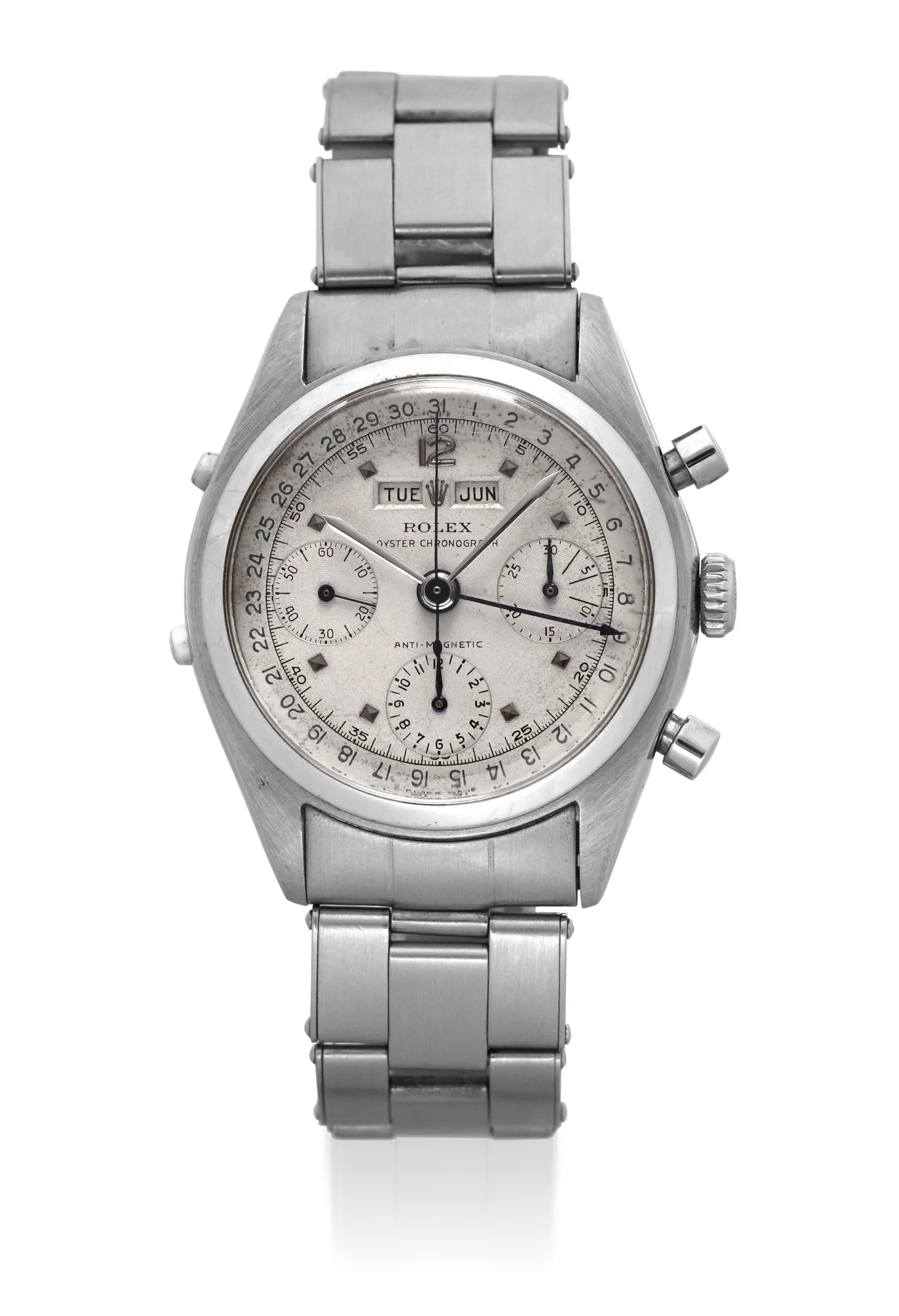 Steel ref. 6036, case number partly masked as 8470XX, catalogued circa 1953. Photo: Antiquorum.
-
The same Antiquorum example, showing its crown, pushers and case profile. Photo: Antiquorum.
-
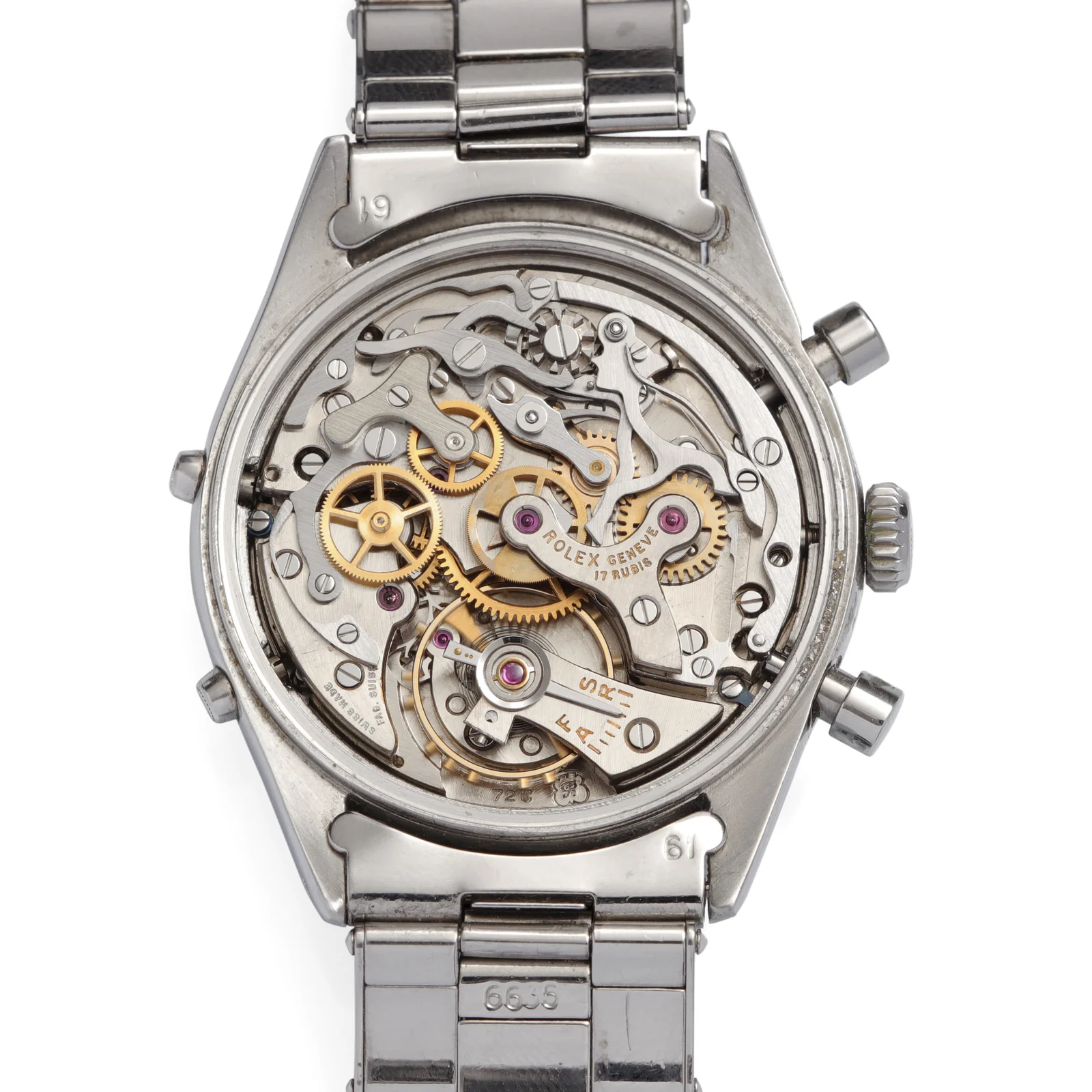 The same watch with its movement visible; the plate is marked 72C. Photo: Antiquorum.
-
The inside caseback is stamped 6036 and stainless steel. Photo: Antiquorum.
Sources
- "Phillips, Hong Kong Watch Auction XXII, lot 1083, ref. 6036 Oyster Solo", Phillips, 2023
- "The Golden Age of the Triple Calendar", Phillips Watches; Logan Baker, 2026-04-09
- "Sotheby's, ref. 6036, case 847031, lot 1069", Sotheby's, 2019
- "Sotheby's, ref. 6036, case 943980, lot 275", Sotheby's, 2017
- "Antiquorum, ref. 6036, lot 108, Monaco 2024", Antiquorum, 2024-07-13
- "Antiquorum, ref. 6036, case 847048, lot 361, Geneva 2022", Antiquorum, 2022-05-08
- "Antiquorum, ref. 6036 Serpico y Laino, Geneva 2023, lot 431", Antiquorum, 2023-05-15
- "Antiquorum, ref. 6036 case 917889, Geneva 2026, lot 655", Antiquorum, 2026-05-10
- "Christie’s, ref. 6036 case 917876, lot 495", Christie’s, 2014
- "Christie’s, ref. 6036 case 847123, lot 235", Christie’s, 2016-11-14
- "Christie’s, ref. 6036 case 685525, lot 2050", Christie’s, 2023-11-06
- "Sotheby’s, ref. 6036 case 943994, lot 132", Sotheby’s, 2025
- "Monaco Legend Group, ref. 6036 case 847210, lot 54", Monaco Legend Group, 2025-10-18
- "Christie’s Dubai, ref. 6036 case 917903, lot 136", Christie’s, 2021
- "Christie’s, ref. 6036 case 944072", Christie’s, 2013
- "Sotheby’s, ref. 6036 case 917831, lot 297", Sotheby’s, 2014
- "Bonhams, ref. 6036, lot 63, Fine Watches, 2020", Bonhams, 2020
- "Rolex Passion Report, “The Rolex Dato Compax alias Jean Claude Killy”", Rolex Passion Report; Philipp Stahl
- "What Is the Rolex Oyster Dato-Compax?", Bob's Watches; Cate Misczuk
- "Uhren-Muser, ref. 6036, case 113771, lot 17", Auktionen Dr. Crott / Uhren-Muser archive, 2021-11-13
- "Monaco Legend Group, ref. 6036, case 685524, lot 175", Monaco Legend Group, 2024
- "Rolex Dato Compax", Watchlover, 2017-03-11
- "Rolex Forums, “Triple date complication,” 2012", Rolex Forums, 2012-08-22