
Rolex Oyster Dato-Compax 6236
Pre-Daytona chronographs → 6236

Reference 6236 was the final Oyster Dato-Compax, Rolex’s manual-wind chronograph with day, month and pointer-date displays. Published date ranges differ: Watchlover, Antiquorum and Sotheby’s give 1958–1962, webChronos gives 1958–1963, and a 2026 Christie’s essay gives 1958–1964. The auction records reviewed here identify numbered steel cases, with one Christie’s catalogue listing a 72B movement and most others naming 72C. Antiquorum also catalogued an unnumbered pink-gold 6236 in 1998; webChronos describes the reference as steel only.
Core facts
| Field | Detail |
|---|---|
| Reference | 6236 |
| Model | Oyster Dato-Compax, triple-calendar chronograph |
| Place in the line | Final Dato-Compax reference, after 6036 |
| Published date band | 1958–1962 (Watchlover; Antiquorum 2025; Sotheby’s 2023); 1958–1963 (webChronos); 1958–1964 (Christie’s 2026) |
| Case material | Numbered auction examples cited here are steel; Antiquorum’s 1998 unnumbered pink-gold attribution is disputed |
| Case diameter | 36 mm in the reviewed auction catalogues |
| Movement | Auction listings mostly identify Valjoux 72C/17 jewels; Christie’s lists 72B/17 jewels on case 576,456. The Vintage Rolex Field Manual also conflicts internally, listing both calibers |
| Calendar | Day and month windows; pointer date on an outer track |
| Chronograph | Central seconds, 30-minute and 12-hour registers |
| Case | Oyster construction with screw-down back and crown; separate bezel |
Where it sits in the line
The 6236 followed the Oyster-cased 6036 and was the last Dato-Compax. Its calendar uses two windows below 12 and a central hand to point to the date on the outer dial track. Three registers show running seconds, elapsed minutes and elapsed hours. The 6238 has a simpler chronograph layout and no calendar.
Collectors use “Jean-Claude Killy” for the Dato-Compax family. Bob’s Watches repeats a rumor that Killy wore a late 6236, then states that he owned one without citing a source. In 2009, Jake Ehrlich wrote that he had seen no photograph of Killy wearing a Dato-Compax; Fratello later makes the same point. The nickname belongs to the model family; the cited accounts do not identify an individual 6236 as Killy’s.
Production outline
Watchlover, Antiquorum’s 2025 family chronology and Sotheby’s 2023 catalogue give 1958–1962; webChronos gives 1958–1963; Christie’s gives 1958–1964. Most numbered auction cases below are dated circa 1958–1960. Antiquorum’s 1998 catalogue dates its unnumbered example to the 1960s. Its 2023 listing for case 576,391 gives circa 1978, far outside the other published ranges and inconsistent with the circa-1960 dates attached to nearby case numbers. That single catalogue date is an outlier, not a sound production endpoint. Sotheby’s says case 384,253 appeared in its 2007 sale before its 2026 listing, so those are two records for one watch. Christie’s relays an estimate of about 215 steel examples, about 55 then known to the market, without naming the scholars or explaining the count.
The catalogue dates and production estimate are not factory records. They do not establish production endpoints or a verified total.
Movement notes
Exact-reference catalogues usually identify a hand-wound Valjoux 72C with 17 jewels. Christie’s lists 72B/17 jewels on case 576,456. The Vintage Rolex Field Manual also conflicts internally: its Dato-Compax table gives 72C, while its reference index gives 72B. These are catalogue identifications; the images reviewed here do not show a readable movement engraving.
Valjoux 72C is the calendar version of the 72 chronograph, with day and month displays, pointer date and a 12-hour counter. Christie’s describes two calendar correctors in the case band, separate from the two chronograph pushers. See the Movements guide for the source conflict and broader caliber lineage.
Dial map
The standard layout has day and month windows at 12, a blue date track around the edge, and a central arrow-tipped date hand. The three registers show running seconds at 9, a 30-minute counter at 3 and a 12-hour counter at 6. Auction photographs show silvered and two-tone silvered dials, faceted hour markers and luminous accents.
Christie’s describes open 6 and 9 numerals on case 384,205. Phillips records closed numerals on case 384,226 and says the styles overlapped. The cited examples show no date or serial cutoff.
Christie’s and Uhren-Muser both catalogue case 384,233, but describe its calendar discs differently: Christie’s says Spanish, Uhren-Muser says Italian. In the Uhren-Muser photograph, the windows read “DOM” and “FEB,” abbreviations compatible with both languages, so the picture does not settle the difference. Other auction photographs show English discs. These records establish at least English and one Romance-language configuration, but do not resolve the language on case 384,233.

Case, bezel, crystal, and crown
Auction catalogues describe a 36 mm Oyster case with a screw-down back and crown. The 6236 has a three-part case: a separate bezel sits above the center case and back. Christie’s and Phillips describe the bezel as larger than on the preceding 6036. The chronograph pushers are round and do not screw down; separate case-band correctors adjust the calendar. Uhren-Muser identifies a Twinlock crown on case 384,233.
The cited catalogues give no crystal material or water-resistance test for these surviving watches.
-
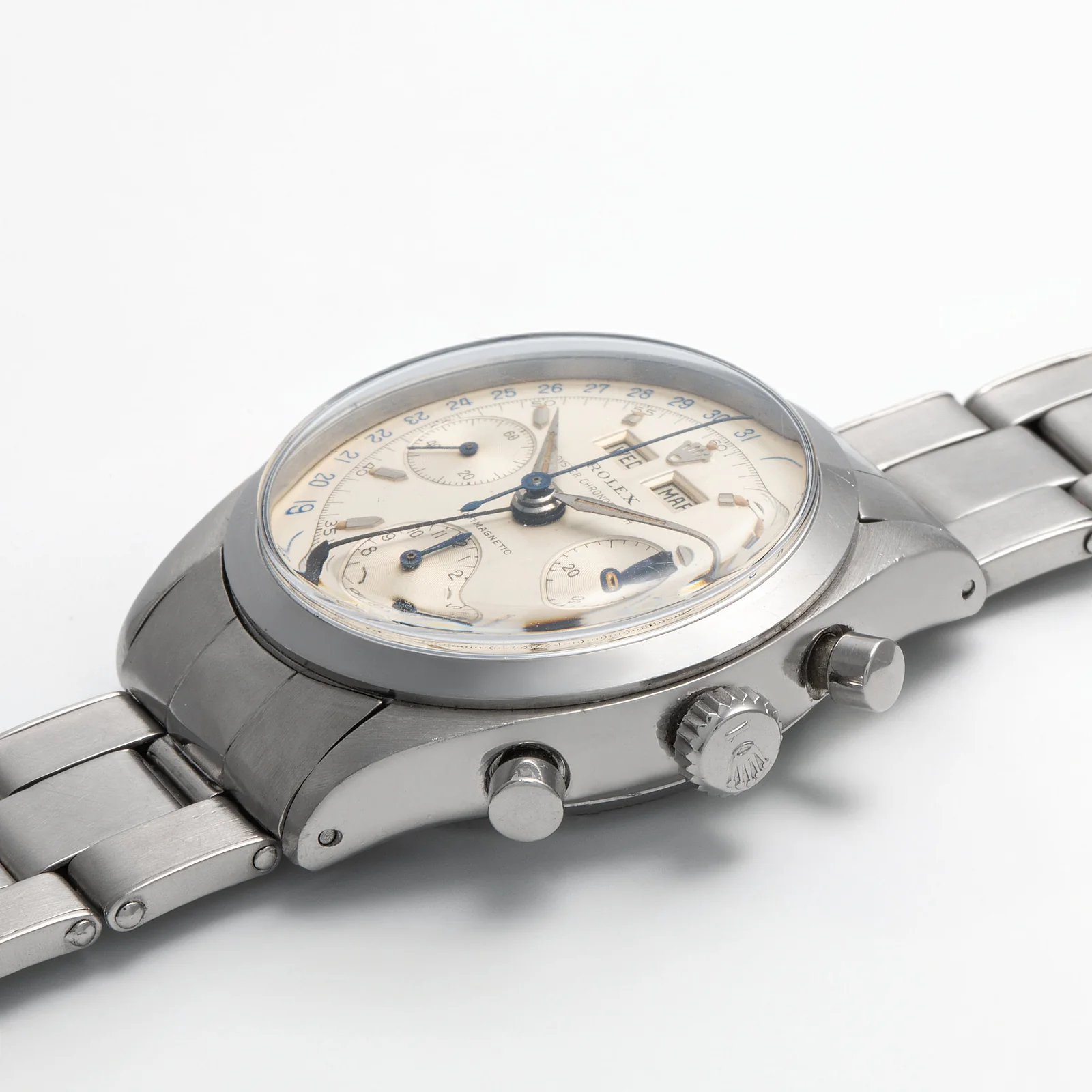 Case flank, crown and chronograph pushers on case 576,447. Photo: Monaco Legend Auctions.
-
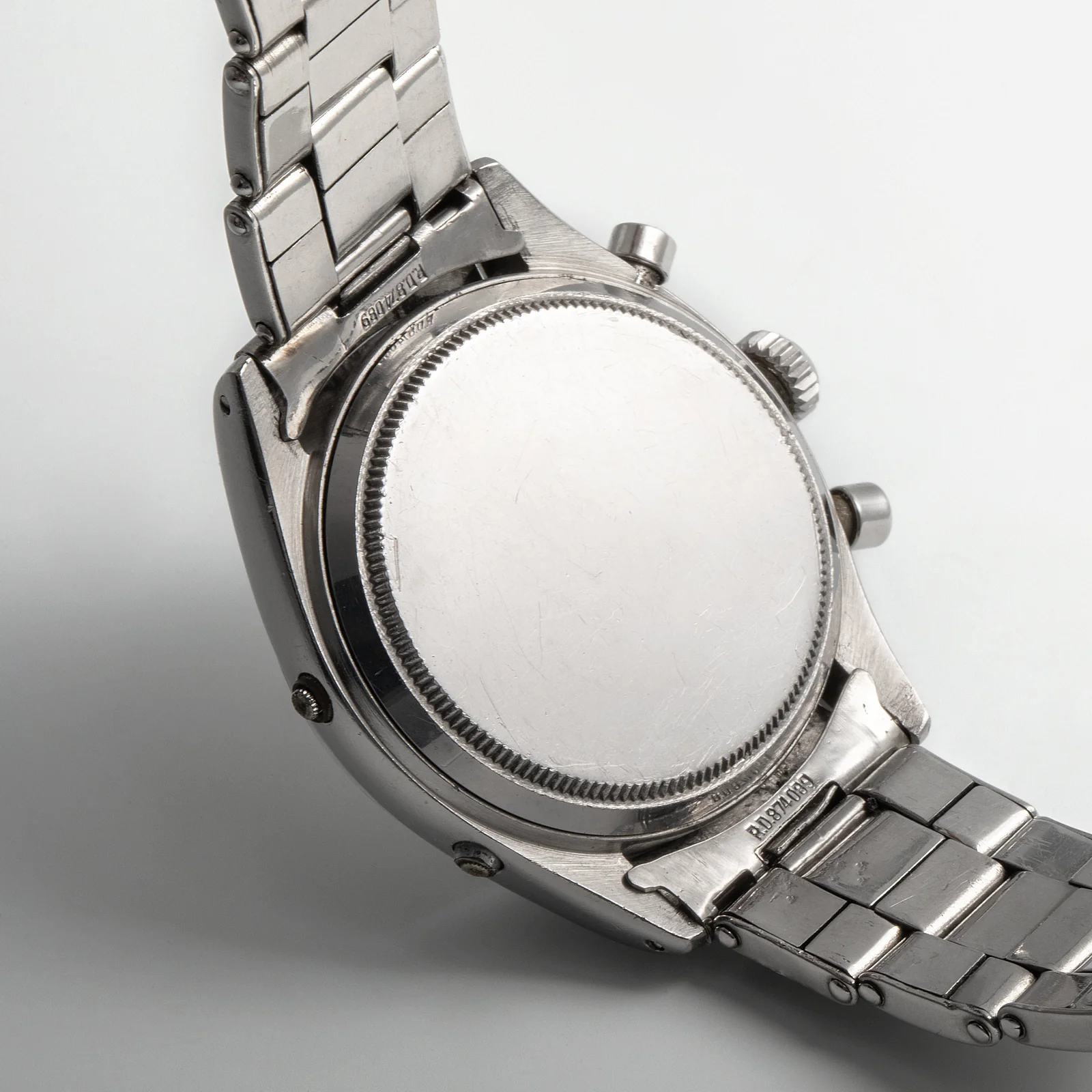 Exterior caseback and bracelet on case 576,447. Photo: Monaco Legend Auctions.


Bracelets, end links, clasps, and packaging
Catalogued examples appear on Jubilee bracelets, riveted expandable Oyster bracelets and folded Oyster bracelets. Phillips records expandable links stamped 71 and a clasp marked “3 59” on case 576,381. Uhren-Muser lists a later folded Oyster bracelet, ref. 7835/19, with 371 end links on case 384,233. Christie’s describes a Jubilee bracelet on case 384,205; Sotheby’s records an expandable Oyster bracelet on case 384,253. The listings show sale configurations; they do not establish original-delivery fitment across the reference.
These are sale configurations, not a standard original-delivery specification. A clasp stamp dates the bracelet or clasp, not the watch head. One Phillips example came with a box; that listing documents the lot, not standard packaging for the reference.

Special branches
Antiquorum’s 1998 New York catalogue calls an unnumbered watch an 18K pink-gold 6236 and describes a 13-ligne, 17-jewel movement. webChronos says the reference was cased only in steel. The numbered cases in the auction records below are steel; Antiquorum gives no case or serial number for its gold example. It documents a published gold-case attribution, but does not establish a verified gold variant. The sources reviewed here also give no firm evidence for a military or retailer-signed 6236 branch.
Auction records
| Sale record | Watch and catalogue details |
|---|---|
| Christie’s Geneva, lot 81 | Case 384,205, circa 1958; two-tone silvered dial, open 6 and 9, 72C/17 jewels and Jubilee bracelet. Catalogue |
| Uhren-Muser, 95th Auction, lot 348; Christie’s Geneva, lot 249 (2014) | Both catalogues identify case 384,233, circa 1958, and list 72C/17 jewels. Christie’s calls the calendar Spanish; Uhren-Muser calls it Italian. The visible “DOM” and “FEB” do not distinguish the two. Uhren-Muser · Christie’s |
| Phillips Geneva Watch Auction X, lot 118 | Case 384,226, circa 1958; steel, 72C/17 jewels and 36 mm diameter. Catalogue |
| Phillips Geneva Watch Auction XV, lot 193 | Case 576,381, circa 1960; steel, 72C/17 jewels, expandable bracelet with 71 end links and clasp stamp “3 59.” Catalogue |
| Christie’s Geneva, lot 81 (2011) | Case 576,456, circa 1960; steel, 36 mm, two-tone silvered dial; Christie’s identifies 72B/17 jewels. Catalogue |
| Sotheby’s Geneva, lot 76 (2023) | Case 576,364, circa 1960; steel, 72C/17 jewels and Jubilee bracelet. Sotheby’s identifies it as property from the original owner’s family. Catalogue |
| Sotheby’s Geneva, lot 123 (2021) | Case 576,401, circa 1960; steel, 72C/17 jewels, 36 mm and Jubilee bracelet. The catalogue identifies it as from the original owner’s family. Catalogue |
| Antiquorum Monaco, lot 226 (2023) | Case 576,391, steel; catalogue date circa 1978 conflicts with the date bands and circa-1960 descriptions for other examples. Treated here as a dating outlier. Catalogue |
| Christie’s, case 576,449 | Catalogued circa 1960; Christie's records the watch as from Eric Clapton’s collection and cites its earlier 2003 sale, lot 180. The listing describes two calendar correctors, two chronograph pushers, and a 36 mm case. Catalogue |
| Christie’s, case 384,255 (2014 and 2026 sales) | Both catalogues describe the same numbered case. The 2014 entry identifies 72C/17 jewels and dates production 1958–1962; the 2026 listing gives 1958–1964 and relays the 215/55 estimate. 2014 catalogue · 2026 catalogue |
| Monaco Legend Auctions, lot 242 | Case 576,447, catalogued circa 1960; steel, 72C/17 jewels. Catalogue |
| Sotheby’s Geneva, lot 84 | Case 384,253, circa 1958; steel, 72C/17 jewels and expandable Oyster bracelet. The catalogue records a previous Sotheby’s sale in 2007. Catalogue |
| Antiquorum New York, 15 December 1998, lot 475 | No case or serial number given; catalogued as a 1960s 18K pink-gold 6236 with a 13-ligne, 17-jewel movement. Its reference/material attribution is unverified and conflicts with webChronos’s steel-only account. Catalogue |
Gallery
-
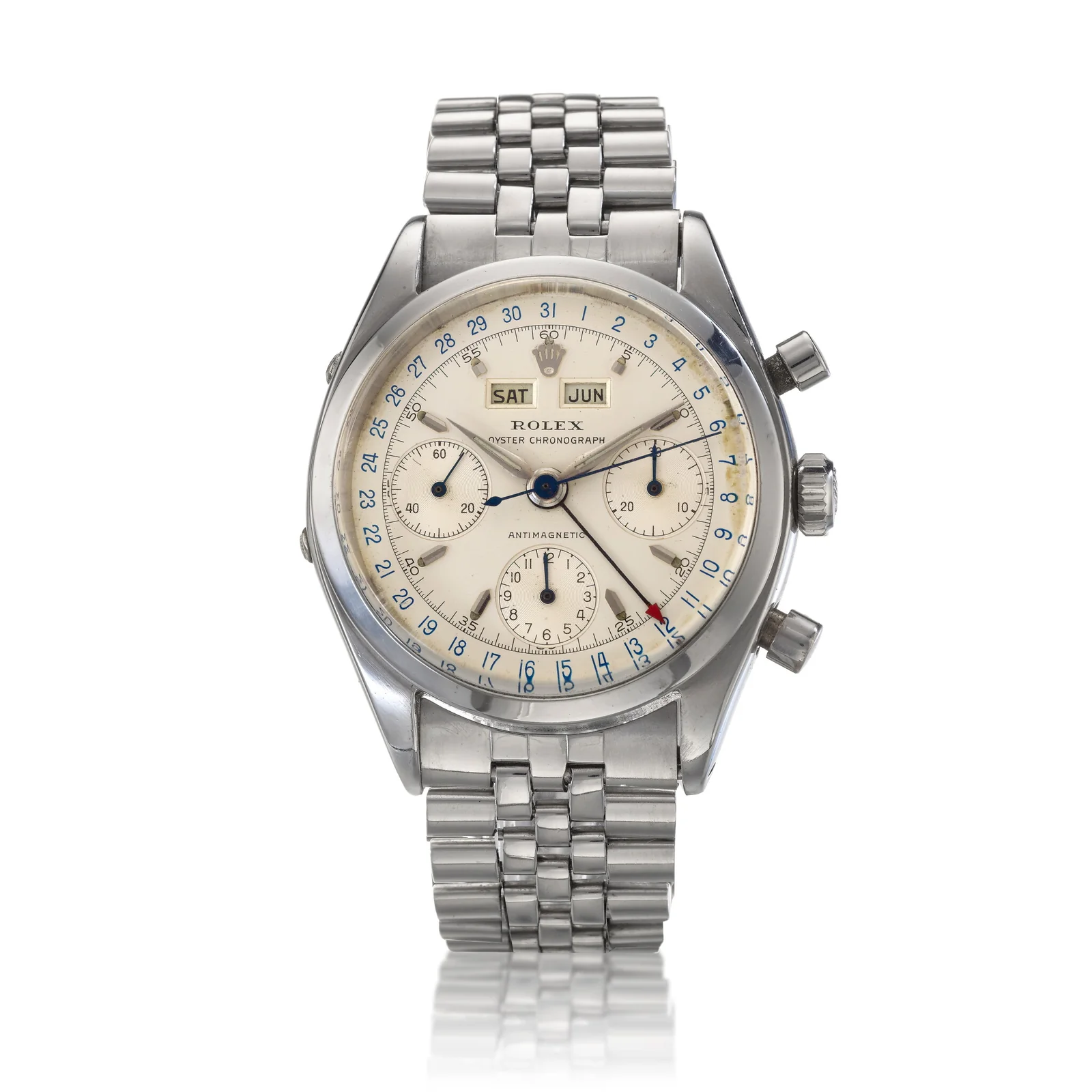 Case 576,401, catalogued circa 1960. Photo: Sotheby’s.
-
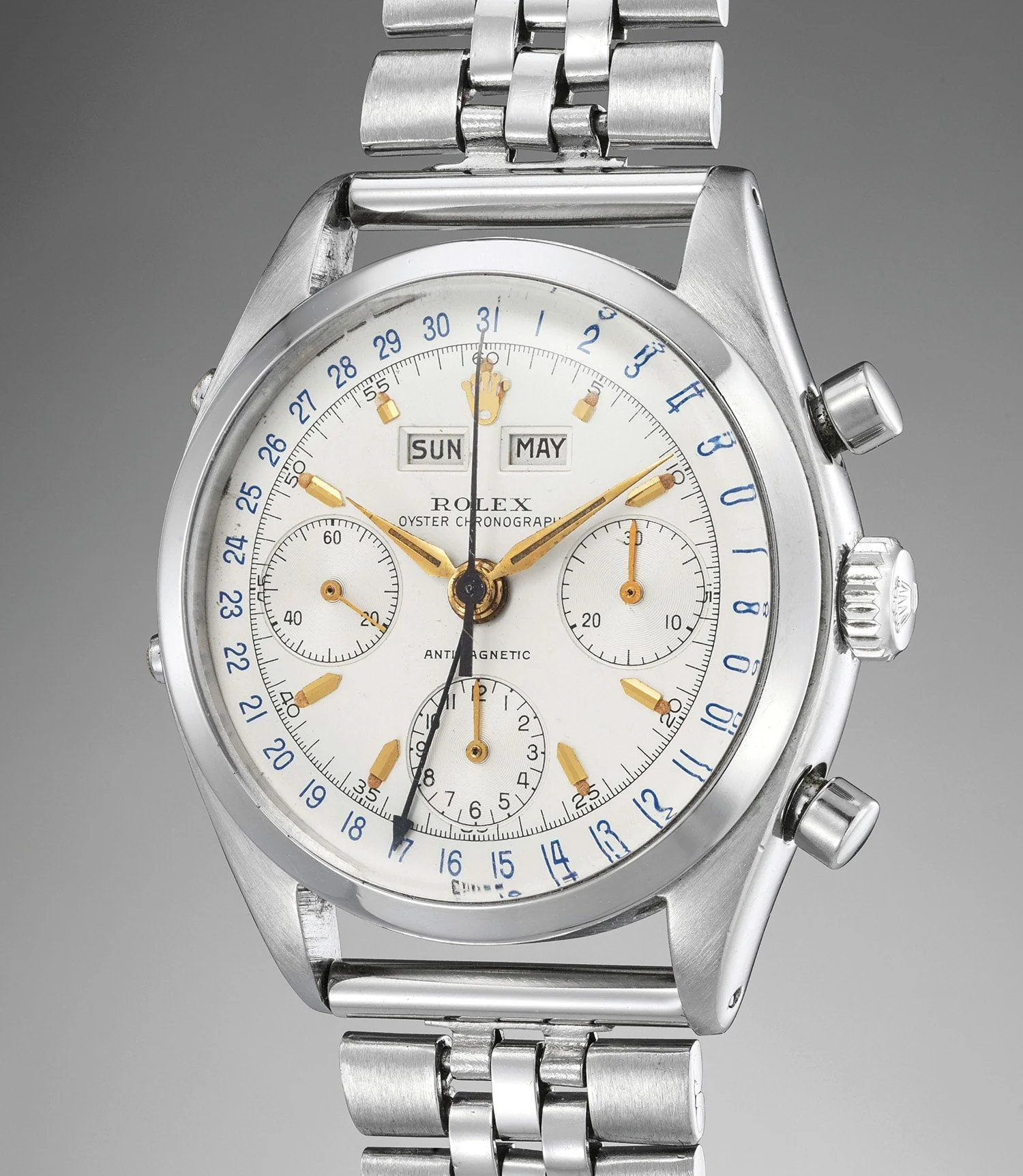 Silvered dial with applied gold markers on case 384,226. Photo: Phillips.
-
Crown, case flank and pushers on case 576,447. Photo: Monaco Legend Auctions.
-
Exterior caseback on case 576,447. Photo: Monaco Legend Auctions.
-
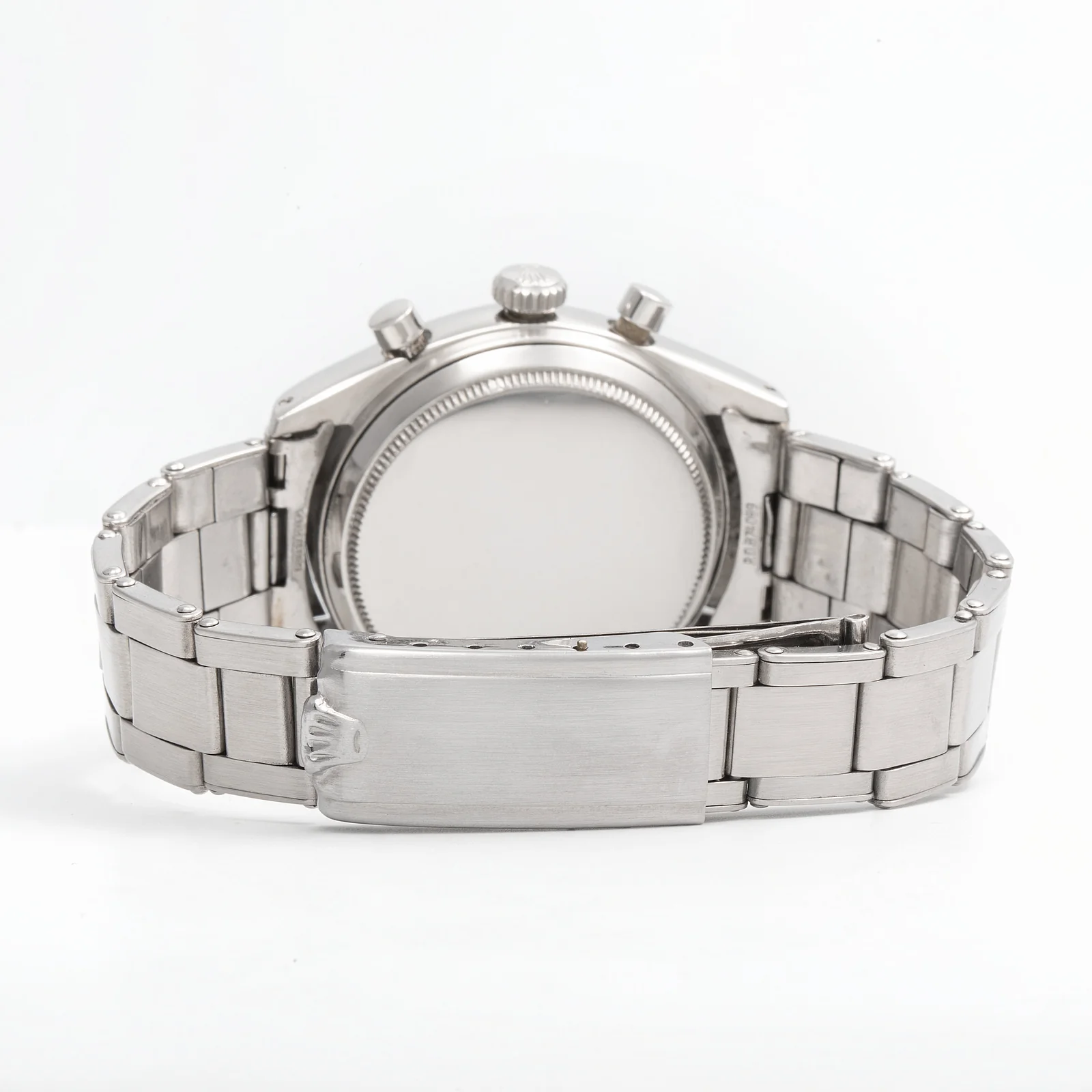 Bracelet and clasp on case 576,447. Photo: Monaco Legend Auctions.
Sources
- "Christie's Geneva, ref. 6236 case 384205, lot 81", Christie's, 2013
- "Phillips Geneva Watch Auction X, ref. 6236 case 384226, lot 118", Phillips, 2019
- "Phillips Geneva Watch Auction XV, ref. 6236 case 576381, lot 193", Phillips, 2022
- "Sotheby's Geneva, ref. 6236 case 384253, lot 84", Sotheby's, 2026
- "Monaco Legend Auctions, ref. 6236 case 576447, lot 242", Monaco Legend Auctions, 2026
- "Christie's, ref. 6236 case 576449, from the Eric Clapton collection", Christie's
- "Uhren-Muser / Dr. Crott, ref. 6236 case 384233, 95th auction lot 348", Uhren-Muser / Dr. Crott, 2017
- The Vintage Rolex Field Manual — Colin A. White, Morning Tundra
- "Rolex Dato Compax", Watchlover, 2017-03-11
- "Rolex Passion Report, “The Rolex Dato Compax alias Jean Claude Killy”", Rolex Passion Report; Philipp Stahl
- "What Is the Rolex Oyster Dato-Compax?", Bob's Watches; Cate Misczuk
- Jake Ehrlich, "Rolex Magazine, “Most Complicated Rolex Ever Made”", Rolex Magazine, 2009-10
- Mike Stockton, "Fratello, “Fratello’s Top 5 Pre-Daytona Rolex Chronographs”", Fratello
- "Rolex Forums, “Triple date complication,” 2012", Rolex Forums, 2012-08-22
- "Christie's, ref. 6236 case 384255", Christie's, 2026
- "Antiquorum New York, ref. 6236, lot 475", Antiquorum, 1998-12-15
- "Antiquorum Geneva, ref. 6036 lot 666, Dato-Compax chronology", Antiquorum, 2025-05-10
- "Two Kings and the Pinnacle of Rolex Collecting", Chronos Japan / webChronos, 2018
- "Christie’s Geneva, ref. 6236 case 384255 (2014)", Christie’s, 2014
- "Christie’s Geneva, ref. 6236 case 384233 (2014)", Christie’s, 2014
- "Christie’s Geneva, ref. 6236 case 576456", Christie’s, 2011
- "Sotheby’s Geneva, ref. 6236 case 576364 (2023)", Sotheby’s, 2023
- "Antiquorum Monaco, ref. 6236 case 576391 (2023)", Antiquorum, 2023-01-19
- "Sotheby’s Geneva, ref. 6236 case 576401 (2021)", Sotheby’s, 2021-12-09