
Rolex Oyster Speedking Precision 6430
Oyster Precision → 6430

The Rolex ref. 6430 is a manual-wind Oyster Speedking Precision with center seconds and a smooth bezel. Catalogues and caseback marks place examples from around 1960 through 1968. Catalogue records name Cal. 1210, 1215, 1220 and 1225. Cal. 1215 and 1225 have calendars, while the reviewed 6430 dials are no-date.
Core facts
| Detail | Evidence |
|---|---|
| Reference | 6430 |
| Line | Oyster Precision, marketed as Speedking |
| Display | Hours, minutes, center seconds; no date |
| Production | Catalogue examples date to circa 1960, 1962, 1963, 1965 and circa 1968; a factory start or end year has not been documented |
| Case | Stainless steel in the main auction records; one 1963 Christie's lot describes a stainless-steel-and-18K-gold case |
| Diameter | Auction catalogues give 30 mm, 30.5 mm or 31 mm |
| Bezel | Smooth on ref. 6430; Antiquorum and Powerfunk distinguish it from the engine-turned ref. 6431 |
| Movement | Sources attribute Cal. 1210, 1215, 1220 and 1225; some attributions conflict with the no-date dial, and no changeover is documented |
| Bracelet | Auction records document Oyster bracelets on individual examples |
Where it sits in the line
The Speedking name appears on several manual-wind Oyster Precision references. Powerfunk places 6430 and 6431 among the 1960s models, after 6420, 6418 and 6421. The Field Manual lists ref. 6430 with Cal. 1225, a polished smooth bezel, a mid-size case and stainless steel. Powerfunk and Antiquorum describe 6430's plain bezel against 6431's engine-turned bezel.
Antiquorum's 2006 lot is catalogued as both 6431 and 6430 and shows an engine-turned bezel. The joint label leaves the exact reference unresolved; Antiquorum describes 6431 as engine-turned and 6430 as the plain-bezel version.
Production outline
Dr. Crott's 2026 catalogue dates a 30 mm silver-dial example to circa 1960 and lists case no. 520834, Cal. 1210 and an inside-back mark 6430 III/63. The circa-1960 estimate and III/63 caseback mark give different dates; its four photographs show the dial and case exterior, so they do not resolve the discrepancy. Gardiner Houlgate dates a ref. 6430 with serial 745xxx and inside-caseback stamp I.62 to circa 1962. Christie's lists two examples with 1963 caseback stamps. Shellman lists case no. 1208312 as a 1965 example and shows an inside-back stamp read as III.65; Eguchi's caseback photograph shows ref. 6430 and date IV.65 on serial 1297***. Sotheby's dates case 1'759'145 to circa 1968. Powerfunk estimates a 1962–1970 span. These examples document the reference across the 1960s; the factory start and end years remain unknown.
Life on the Wrist estimates one watch to 1954 from its serial, while its photographs show an inside-caseback stamp III.63. The author suggests the back may be a replacement. The two dates remain irreconciled, so this watch cannot anchor an early production date.
Bonhams' 2018 catalogue describes a Speedking with masked serial 174**** as ref. 6340 and Cal. 1125, with an inside-caseback mark I.68. Kaplans' 2026 catalogue identifies serial 1748736 as ref. 6430 and gives Cal. 1225 / movement no. 6265, with the same I.68 mark. The serial prefix raises a possible same-watch match, but the reference and caliber labels differ and Bonhams masks the full serial. The records leave both the identity and any catalogue error unresolved.
Movement notes
Christie's and Dr. Crott list Cal. 1210. Powerfunk gives 1210 or 1220 for refs. 6430 and 6431. Shellman and Eguchi list Cal. 1215; the Field Manual, Sotheby's, Kaplans and EBTH list Cal. 1225. Antiquorum's 6431/6430 lot also names 1225.
Cal. 1215 adds a calendar to Cal. 1210, and Cal. 1225 adds one to Cal. 1220. The reviewed 6430 examples have no date aperture. Shellman and Eguchi photograph opened movements, but their images do not show a readable caliber engraving. The listings do not resolve the mismatch or establish a movement changeover. See the Movements guide for the caliber details.
Dial map
Auction and dealer records show silvered, black and brown-changed dials. Sotheby's' circa-1968 example has a silvered dial with applied baton markers. Christie's describes a circa-1963 black matte dial with gilt printing. A second Christie's 6430 has a black matte dial with gilt railway minute divisions and alternating large dots and Arabic numerals; that watch has a two-tone case. Shellman's 1965 listing calls its dial tropical; the images show a dark surface with brown-changed areas and alpha-style hands. This listing records one example; no factory tropical-dial branch is established here.
Life on the Wrist reports both two-line and three-line Rolex/Oyster/Speedking text layouts. Its caseback and serial point to different dates, leaving the timing of those layouts open. Together, the records document individual dial configurations; they leave the sequence open.
-
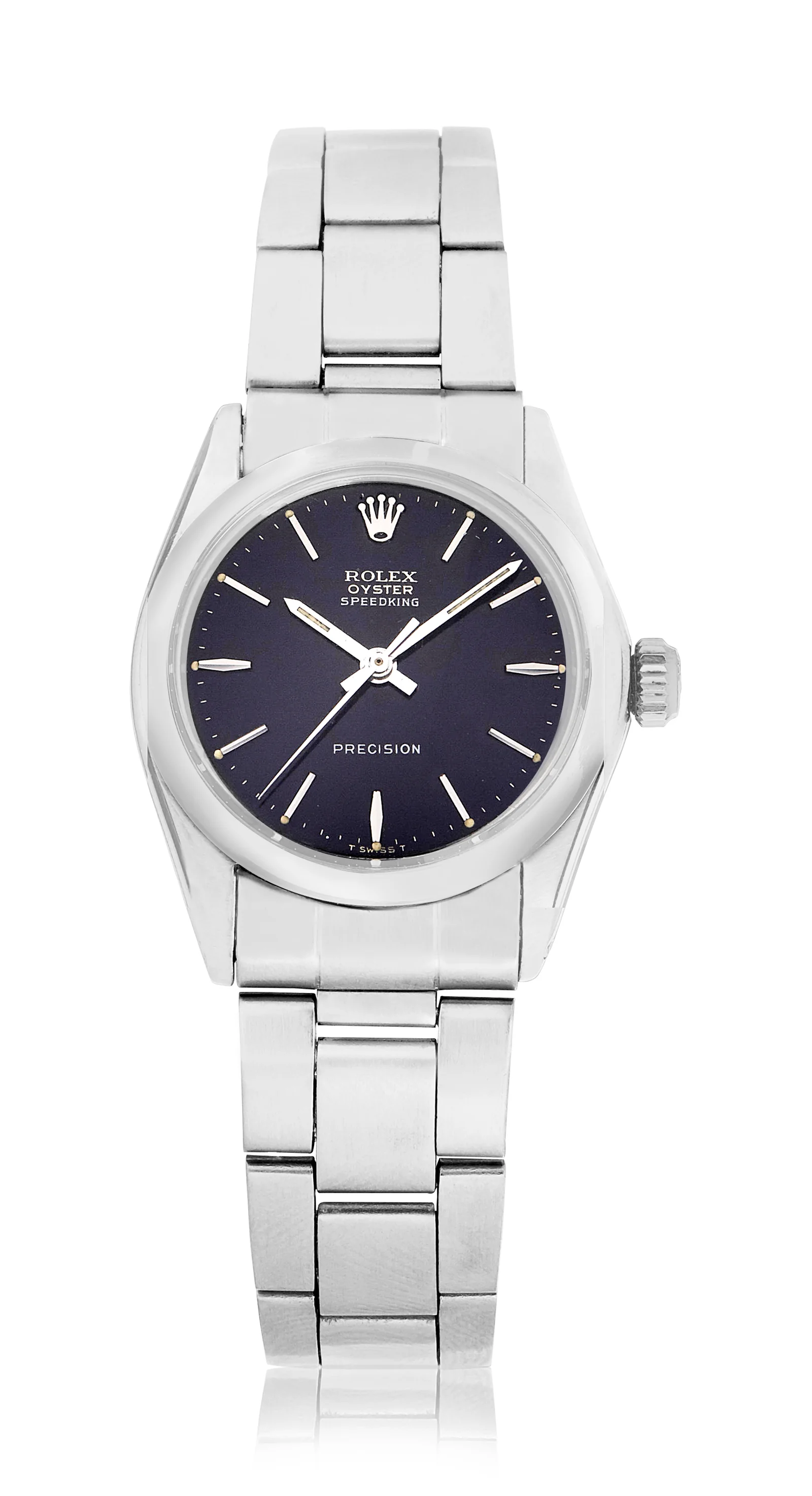 Christie's circa-1963 black-dial ref. 6430, straight-on view
-
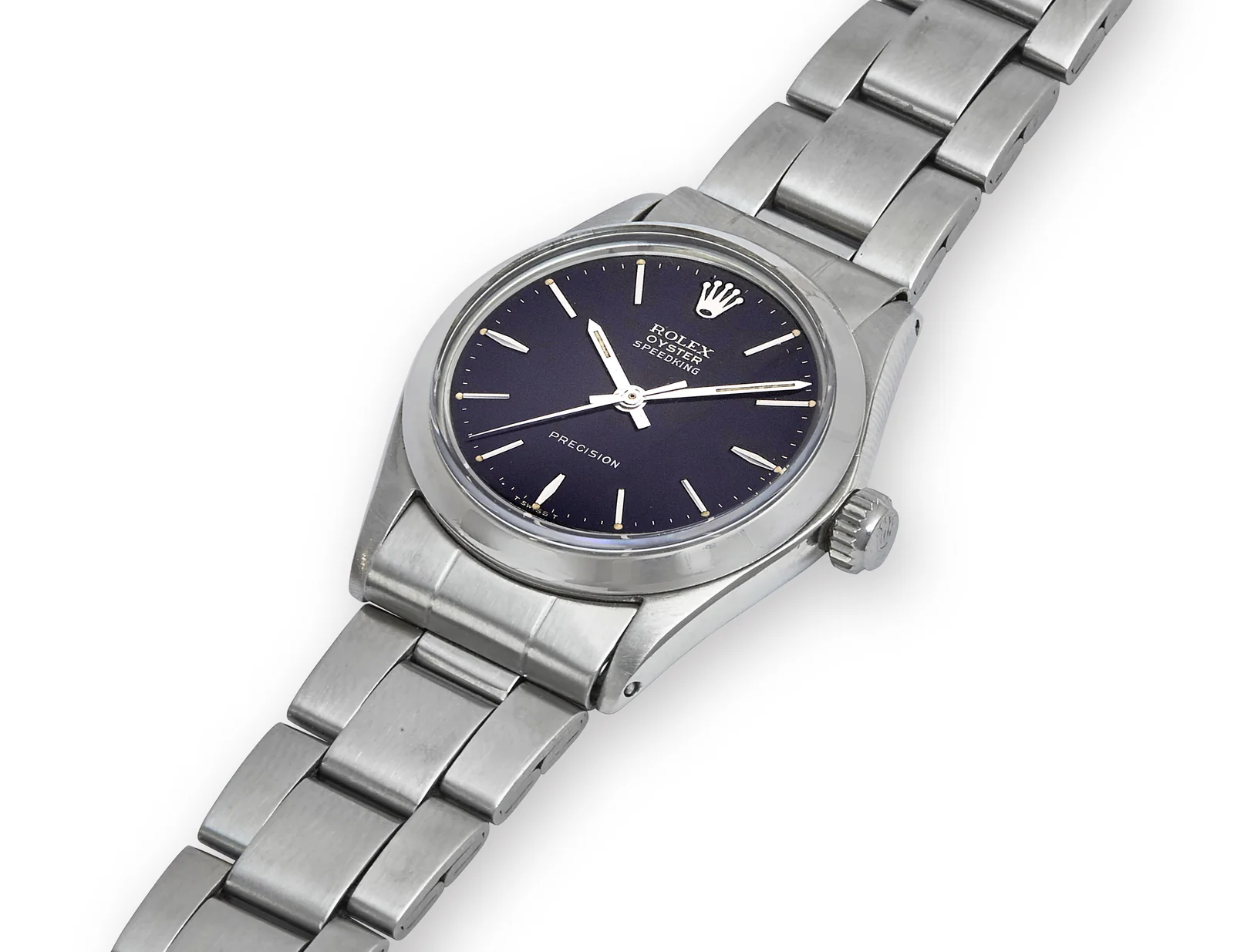 The same Christie's example, angled view


Case, bezel, crystal, and crown notes
Reviewed catalogues and dealer listings give case diameters of 30 mm, 30.5 mm and 31 mm. They use different conventions or do not state how they measured the watch. Most examples are stainless steel. Christie's also catalogues one stainless-steel-and-18K-gold case.
The 6430 uses a smooth bezel. Antiquorum describes the engine-turned bezel on the 6431 and says 6430 is otherwise the same watch with a plain bezel. Its 2006 lot carries both reference numbers and an engine-turned bezel, which leaves that specimen's exact reference unresolved.
Kaplans describes a plastic crystal on its 2026 example. Christie's describes the Oyster case as having a screw-down back and crown. The caseback photographs or catalogues record I.62, I.63, III.63, Shellman's III.65 and Eguchi's IV.65. These codes date marked caseback components; use other evidence to date each complete watch.

Bracelet, clasp, and packaging notes
Sotheby's lists a steel Oyster bracelet on its circa-1968 example. Christie's records a bracelet stamped 7835/17 with end links 351 on its black-dial 6430. Shellman and Eguchi list riveted 7205 bracelets with end link 51; Eguchi gives a bracelet date code 65-3. Gardiner Houlgate describes a bracelet stamped 3.66; the watch's caseback is marked I.62, so the two dates belong to different components. Kaplans identifies a 78350 bracelet as a later replacement.
These records document bracelet setups on individual watches. Reference-wide original-delivery fitment remains unestablished.
Catalogue and market record
| Sale record | Catalogue description |
|---|---|
| Gardiner Houlgate, 20 May 2024, lot 448 | Ref. 6430, serial 745xxx, circa 1962, 30 mm steel case, silvered dial and applied gilt baton markers; caseback I.62; riveted bracelet 3.66; 17-jewel movement without a caliber number.
|
| Christie's Watches Online, Speedking ref. 6430 | Circa 1963, 30 mm stainless steel, black matte dial, Cal. 1210; caseback III.63; bracelet 7835/17 with end links 351. Christie's says the lume was restored.
|
| Christie's Watches Online, Oyster Speedking ref. 6430 | Circa 1963, 30.5 mm stainless steel and 18K gold, black matte gilt dial with railway divisions, Cal. 1210; caseback 6430 / I.63.
|
| Sotheby's, Fine Watches, lot 8031 (2021) | Case 1'759'145, circa 1968, 31 mm stainless steel, silvered dial and Oyster bracelet; catalogue attribution Cal. 1225. The lot images show the dial and case; they do not include the movement. |
| Shellman, archived item D9358 | Case no. 1208312, ref. 6430, listed as 1965 and Cal. 1215. Its images show a no-date dial, an opened movement and an inside-back mark read as 6430 III.65; the caliber marking is not readable. |
| Eguchi Vintage, archived item 266469 | Serial 1297***, date listed as IV.65, 31 mm silver dial and 7205 bracelet with end link 51 / bracelet code 65-3. The spec field says Cal. 1215; the description says 1210 (1215). Its movement image does not make the caliber marking readable. |
| EBTH, item 11427502 (2020) | Stainless-steel ref. 6430, estimated 1965, Cal. 1225 and inside-marking text ending 6430, IV.65. The seven images show no readable movement or inside caseback; EBTH gives no serial number.
|
| Kaplans Auktioner, 8 August 2026, lot 103 | Serial 1748736, ref. 6430, Cal. 1225 / movement no. 6265, 30.5 mm steel, caseback I.68. The catalogue describes a damaged dial, a non-running watch and a later 78350 bracelet. One low-resolution image.
|
| Antiquorum, Geneva, 14 May 2006, lot 20 | Case 3022338, dated 1970/72, 31 mm steel, Cal. 1225, engine-turned bezel. The joint 6431/6430 designation leaves its exact reference unresolved. |
| Bonhams, 20 November 2018, lot 193 | Described as ref. 6340, Cal. 1125, serial masked 174****, 30 mm steel, caseback I.68. Kaplans later lists a 6430 with serial 1748736, Cal. 1225 / movement no. 6265, and the same caseback code. The 174 prefix suggests a possible match, while the reference and caliber attributions differ and Bonhams masks the full serial.
|
| Auktionen Dr. Crott, Online Auction VI, 1 June 2026, lot 117 | Catalogued as ref. 6430, case no. 520834, Cal. 1210, circa 1960, 30 mm steel, silvered textured dial; caseback marked 6430 III/63. The photographs show the dial and exterior case only.
|
Related references
- Oyster Precision, for the broader manual-wind line.
- Movements, for the 1210, 1215, 1220 and 1225 attributions.
- Serial numbers by year, for the limits of serial and caseback dating.
-
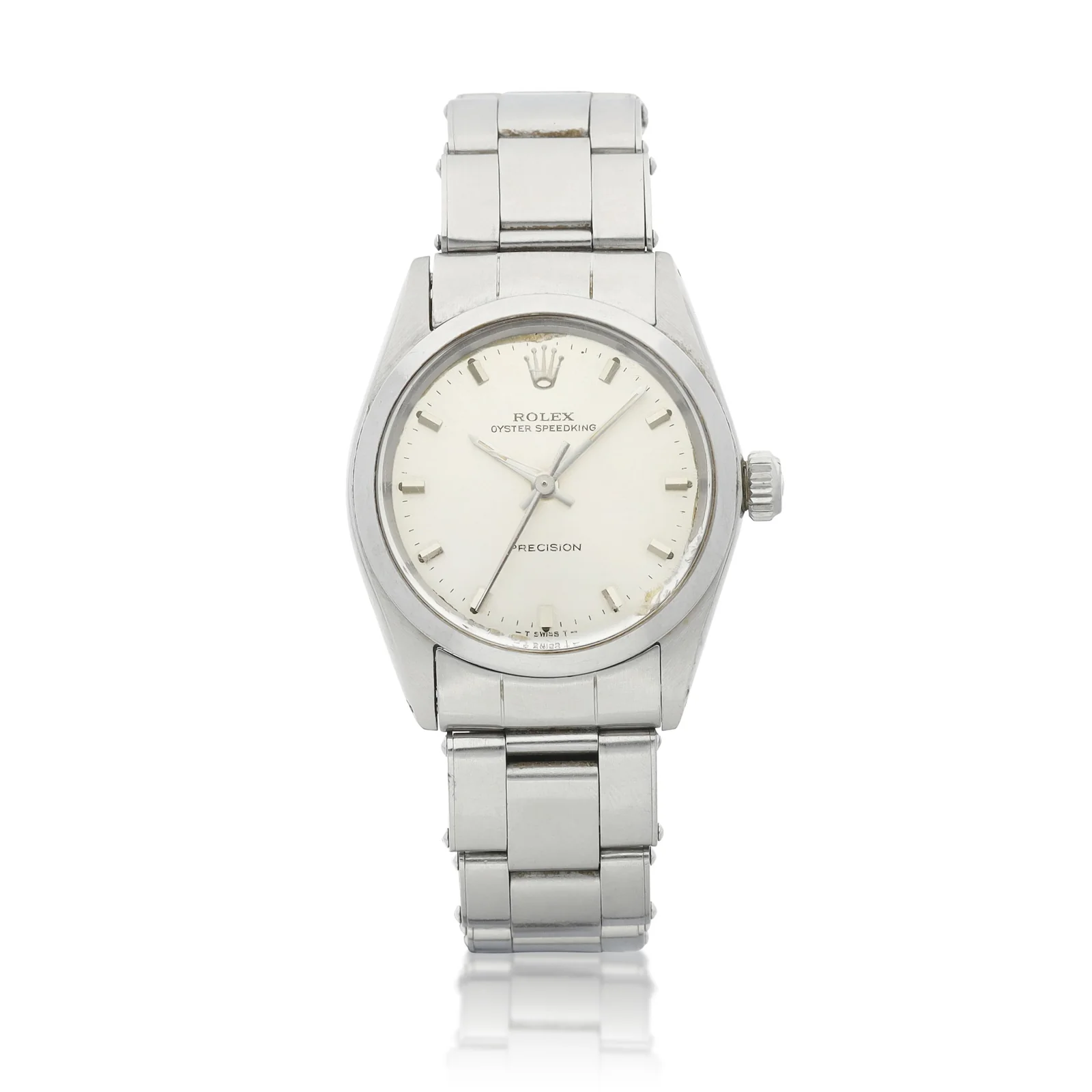 Sotheby's lot 8031, circa-1968 ref. 6430, silvered dial and bracelet
-
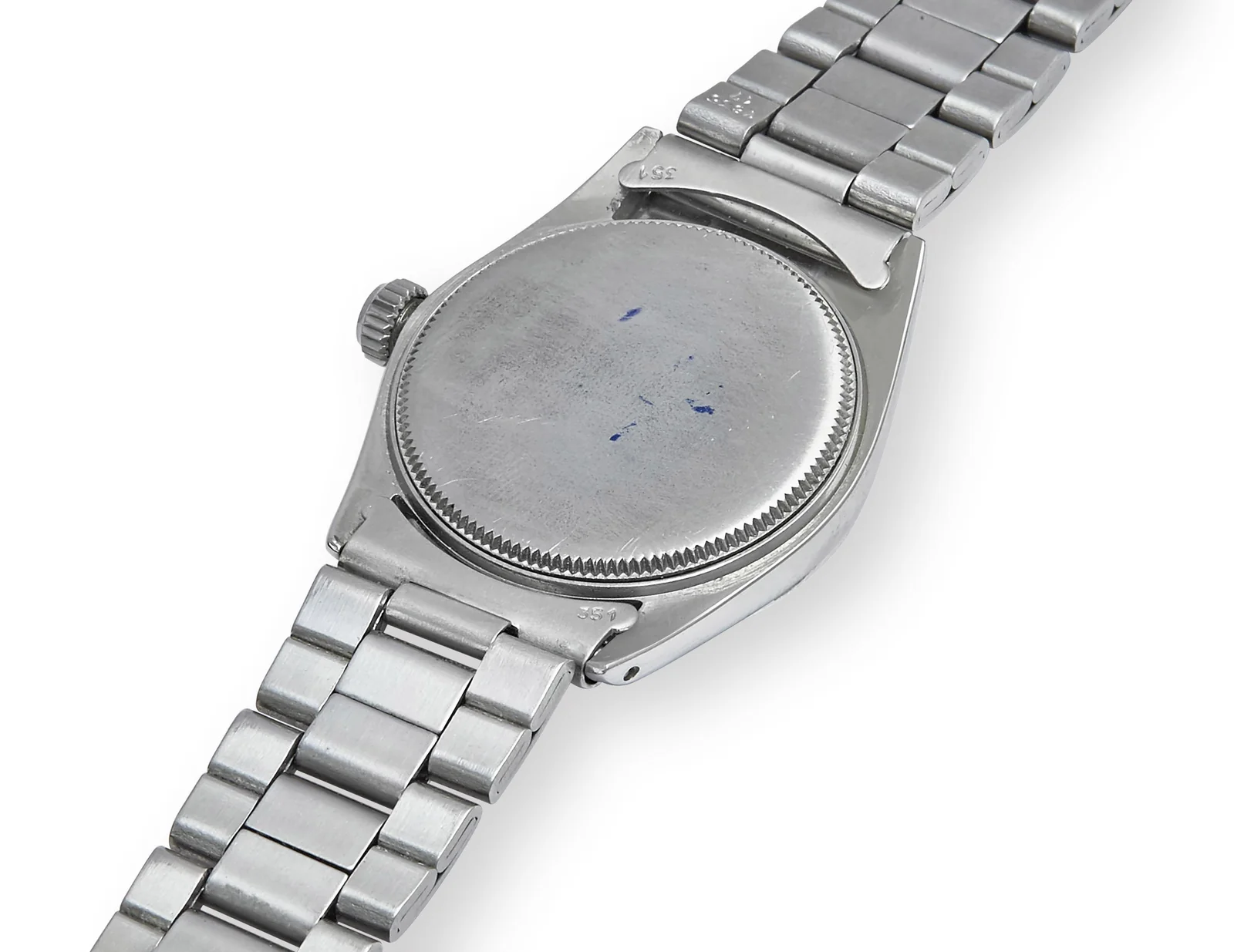 Christie's black-dial example, exterior caseback
-
Christie's circa-1963 black-dial example; separate watch
-
The same Christie's example, angled view
Sources
- "Sotheby's Hong Kong, Fine Watches, lot 8031 — Oyster SpeedKing ref. 6430", Sotheby's, 2021-08-19
- "Christie's Watches Online — Oyster Speedking ref. 6430, black dial, circa 1963", Christie's
- "Christie's Watches Online — Oyster Speedking ref. 6430, two-tone case, circa 1963", Christie's
- "Gardiner Houlgate, 20 May 2024, lot 448 — Oyster Speedking ref. 6430", Gardiner Houlgate, 2024-05-20
- "Antiquorum, Geneva, 14 May 2006, lot 20 — Speedking refs. 6431/6430", Antiquorum, 2006-05-14
- "Kaplans Auktioner, Watches, 8 August 2026, lot 103 — Oyster Speedking ref. 6430", Kaplans Auktioner (catalogue mirrored by Drouot), 2026-08-08
- Powerfunk, "Rolex Speedking: The True History of an Overlooked Rolex", Luxury Bazaar / Grey Market Magazine
- "Life on the Wrist — The King of Speed: Rolex Oyster Precision Speedking ref. 6430", Life on the Wrist
- The Vintage Rolex Field Manual — Colin A. White, Morning Tundra
- "Bonhams, Watches and Wristwatches, lot 193 — Rolex Speedking Precision ref. 6340", Bonhams, 2018-11-20
- "Auktionen Dr. Crott, Online Auction VI, lot 117 — Oyster Speedking Precision ref. 6430", Auktionen Dr. Crott, 2026-06-01
- "EBTH, Vintage Rolex Oyster SpeedKing Precision Stainless Steel Stem Wind Watch, item 11427502", Everything But The House, 2020-05-17
- "Shellman, SPEEDKING Tropical Dial, item D9358 — Rolex ref. 6430", Shellman
- "Eguchi Vintage, Oyster Speedking silver dial, item 266469 — Rolex ref. 6430", Eguchi Vintage Clothing, Watch & Watch Repair Shop